

Choosing the right low-voltage outdoor lighting fixture is critical for delivering quality results that satisfy both homeowners and landscape architects. The wrong fixture can lead to callbacks, poor performance and unhappy clients. The following guide breaks down exactly how to select the proper low-voltage fixture for each application on every job.
Before going out to the job, have the customer send you a picture of their property at night. This will help you know what kind of ambient light you are fighting against.
Low-voltage systems operate at 12 volts, providing a safe and flexible solution for professional landscape lighting installations. A properly sized transformer steps down household power, allowing you to run direct burial cable efficiently across the property. When properly calculated, these systems deliver excellent light quality while keeping voltage drop manageable.
Most transformers are multitap and range from 12 volts to 15 volts. LED products will usually give you a bigger operating range, typically 12–18 volts. Some manufacturers even offer light sources that can run 8–25 volts.
There are several factors to consider when choosing fixtures, including beam spread, lumen output, color temperature and fixture durability. Each plays an important role:
The ability to match the right fixture to the job separates good contractors from great ones. Among other things, knowledge of different styles and materials is key.
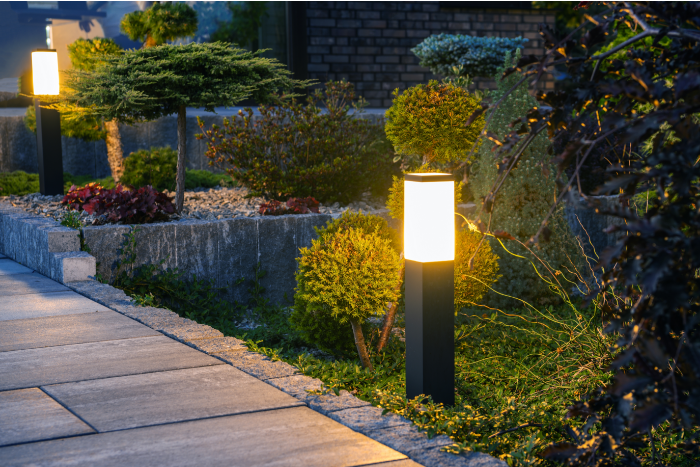
Path lights provide both guidance and safety along walkways. Always ask the customer how well they can see at night, as this may affect which Kelvin temperatures are chosen. Also ask customers who visits them so you can provide appropriate safety throughout the walkway. Avoid putting path lights into lawn areas. If you must, use a heavier-duty spike, such as a rocket or perma-post, that will raise the fixture slightly higher. This will provide the light some protection against lawn equipment.
Each type has a purpose:
Fixture materials and finishes directly affect long-term performance. Choose solid brass or copper for coastal environments, and use powder-coated aluminum for most standard residential applications. Pay close attention to gasket quality and lens options to prevent water intrusion over time.
“The ability to match the right fixture to the job separates good contractors from great ones.”
Planning ahead when lighting trees is one of the most important aspects of professional landscape lighting. Always consider the size the tree will be when mature. A fixture placed close to the trunk today might end up completely shaded or buried in foliage within just a few seasons. Smart contractors plan for the tree’s mature canopy and place fixtures farther back, using narrower beam spreads to reach the upper branches as the tree grows. This approach will keep the lighting effect strong for years instead of just on installation day.
Another technique to consider for trees is down lighting, which can provide a great natural effect in the landscape when done right. Avoid putting fixtures in trees more than 30 feet high, and make sure that you use a proper tree mount for the fixture. The cable going up the tree needs to stay off the bark so it is not consumed as the tree grows, and a drip loop should be created on the cable to help prevent water from getting into the fixture. Consult an arborist to see whether the fixture should be belted to the tree or if it’s OK to screw the fastener into the tree.
To help provide customers exactly what they want and prevent callbacks, there are other steps a professional should take when planning how to best use low-voltage fixtures:
Just as there are steps that should be taken, there are common mistakes that should be avoided:
You should look at several manufacturers when choosing fixtures for your installation. If you’re not sure what to choose, reach out to manufacturers. They normally have tech departments that can help you.
I wish you the best of luck in all of your jobs. If you have any questions, contact me anytime.



3030 Clarendon Blvd. | Suite 300 | Arlington, VA 22201
Tel: 703.536.7080 | Fax: 703.536.7019
HOME | ABOUT | ADVERTISE | SUBSCRIBE | CONTACT | PRIVACY POLICY
| IA ANTITRUST STATEMENT