Spring startups are about more than turning the clock back on and setting it to “run.” They mean it’s time for a thorough inspection to ensure the system has correct pressure and electrical power, valves are working, heads aren’t broken and the system is providing proper coverage.
“It’s important to check the system first to make sure it is operating the way it’s supposed to,” says Greg Bundesen, conservation and communications supervisor for Sacramento Suburban Water District in California.
Spring irrigation system startups may feel routine, but they’re among the most critical moments of the irrigation season. Imagine missing a leak caused by the winter freeze-thaw cycle, or failing to check spray patterns, and having to pay a customer’s bill for 10,000 or 20,000 unneeded gallons of water.
That scenario isn’t hypothetical — it has happened to seasoned contractors who skipped a critical check or trusted that a system “looked fine” without testing pressures and continuity.
Kenny Shiflett, CIC, CLIA, senior manager of All Seasons Irrigation & Lighting in Virginia, has nearly four decades of industry experience. Successful spring startups, he says, boil down to a thorough check and a simple process.
“After all these years, I’ve learned to start at the simplest point and work my way through the system without overthinking it,” he says.
Creating a checklist that includes a visual inspection that can be followed on every site can help your crew find and fix problems before they become expensive projects later in the season.
Start with the electrical components
It sounds basic, but the first step to turning on a system is confirming whether the controller remained plugged in and checking the face plate to confirm it’s displaying the correct date and time.
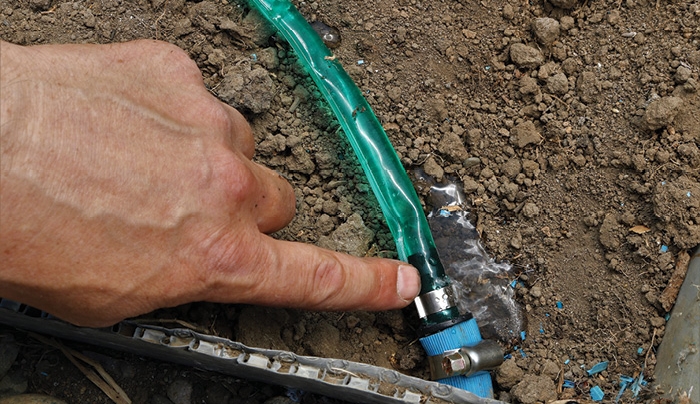
When Shiflett opens a system, he starts by checking for electrical continuity across the wiring in each zone, the solenoid and the common wire. Most modern controllers have built-in diagnostic tests or test programs that allow manual operation of all stations to check for physical problems.
“Even with the technology and software, I still like to do this test on the controller,” Shiflett says. “A few years ago, I had continuity on everything in a system, but by the time I got to zone eight, there was a short, but it wasn’t a short to the meter. The customer had unplugged the controller over the winter, and it needed a software update.”
For controllers without built-in testing capabilities and for more advanced troubleshooting, a voltmeter confirms proper voltage — 24 volts — is coming into the system. Check the manufacturer’s specs for optimum solenoid operation, but most require between 25 and 50 ohms. A voltmeter reading near zero indicates a short, while an infinity symbol or “OL” means there is an open wire somewhere.
This is also a good time to check the program in the clock. Many homeowners — and even some maintenance crews — use the same watering schedule year after year. This is one of the most significant barriers to system efficiency.
“Many people use the same schedule all year. In California, you don’t need as much irrigation in early spring or late fall as you do midseason,” Bundesen says.
Monthly adjustments keep the system aligned with weather conditions. Smart controllers make this easier, but they still need proper setup and calibration. Contractors should use the startup season to revisit run times, evapotranspiration settings, cycle-and-soak logic and local climate patterns.
Confirm pressure and inspect every zone
Before heading to jobsites to start up a system, know the state and municipality requirements for backflow preventers. There is no federal law requiring backflow preventers or inspections, but individual states and local governments may have established codes that must be followed.
If needed on your site, confirm whether required inspections have been completed, or make a note to arrange them with your customer if they are part of your maintenance plan or need to be done. Check for any visible cracks or damage caused by a winter freeze, make sure the drain plug is tight and ensure the valves are closed. Backflow failures can create leaks downstream that are nearly impossible to detect without proper testing, and small leaks can go undetected until the customer’s water bill is larger than anticipated.
Then open the valves to allow water to enter the system slowly. Open one zone first and allow it to operate until a steady stream comes out to ensure any trapped air is evacuated from the mainline.
“After the water is on, I put a pressure gauge on the downside of the backflow-prevention device, and if you have any leak, it will make the gauge drop quickly,” Shiflett says. “If you have a leak, even a midsize to small leak is going to show pretty quickly.”
An undetected leak, even a tiny hole in the pipe, can waste 6,300 gallons of water monthly, according to the Environmental Protection Agency (EPA). Checking pressure at the backflow can quickly identify small problems before they add up and become a larger issue.
“The pressure gauge on the backflow weakens out, and if you don’t test it, you don’t even know it,” he adds. “I’ve paid for some people’s water bills. I had technicians out, and they didn’t check for leaks and maybe didn’t think a half-gallon a minute. But if you don’t catch it, it can get to 20,000 gallons.”
“Take the IA classes, especially the [Landscape Irrigation Auditor] class. Those classes have been really helpful and shed light on being efficient with water.”
— Kenny Shiflett, CIC, CLIA, senior manager, All Seasons Irrigation & Lighting
Walk the site, inspect the system
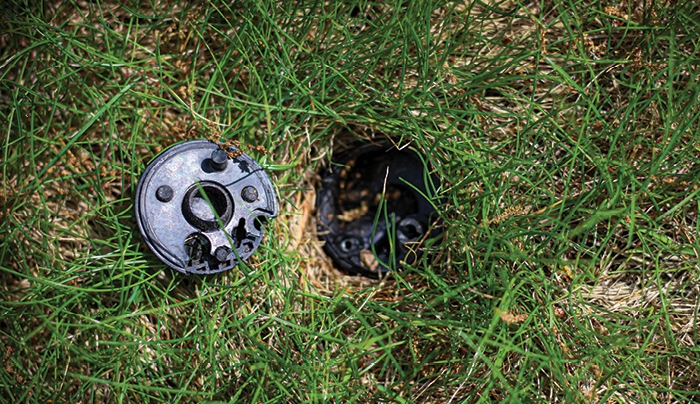
A visual inspection of the system while it operates is essential for identifying potential leaks and broken heads that may contribute to overwatering. Fittings, joints or valves are common locations for leaks, and snowplows can easily damage heads. Leaks are one of the most preventable irrigation system issues, and repairing them can save homeowners from incurring significant water bills. According to the EPA, a broken sprinkler head can waste 25,000 gallons of water in six months.
“I live in a locality where water is costly and water is a natural resource we want to conserve, so we want to make sure there are no small leaks,” Shiflett says.
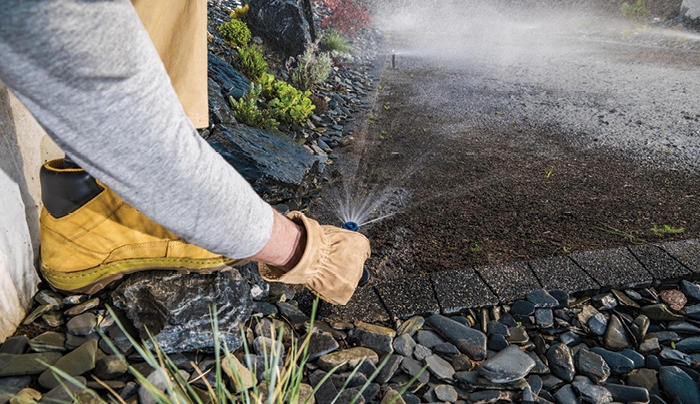
Although the grass won’t be soggy like it would be if a leak sprouted in midsummer, watch how the sprinklers are working. Make sure each head pops correctly during zone tests and notice any that may be tilted or out of proper alignment. A geyser of water coming from a head is an obvious indication of a problem, but other issues may be more subtle, making it important to walk sites for visual inspections.
While the system is running, confirm head-to-head coverage and proper nozzle usage. “If you have a sprinkler that’s going to be irrigating a turf area, you don’t want the sprinkler to be overspraying onto a sidewalk or a driveway,” Bundesen says.
Shiflett adds that on some sites, you must watch the head work or remove the nozzle to confirm what’s being used. “Manufacturers don’t all use the same markings anymore. Over time, the color systems have changed,” he says.
“If you have a sprinkler that’s going to be irrigating a turf area, you don’t want the sprinkler to be overspraying onto a sidewalk or a driveway.”
— Greg Bundesen, conservation and communications supervisor, Sacramento Suburban Water District
 Train crews before startup season arrives
Finding skilled crew leaders and laborers is an industrywide challenge. Investing in training before startup season begins is crucial, not only to work on jobs you’ve installed and maintained, but also to take on new contracts.
Imagine having an untrained technician disconnect the communication wire and the pump start relay, burning out the pump or unknowingly connecting the two-wire system to the wrong ports, causing the controller not to turn on, thinking it’s a faulty controller and trying to sell the customer a replacement.
Or picture an untrained technician turning the wrong valve on or off, affecting the main water supply to the entire house or commercial building and potentially drawing down pressure across the entire building. “Take the IA classes, especially the [Landscape Irrigation Auditor] class,” Shiflett says. “Those classes have been really helpful and shed light on being efficient with water.”
Help customers tap into savings
The EPA encourages contractors to replace standard controllers with WaterSense-labeled controllers to help owners reduce irrigation system usage by up to 15,000 gallons a year. Not only does that help property owners save an estimated $4.5 billion in water costs, it reduces national water usage by 390 billion gallons, according to the agency.
Some municipalities and utility companies offer rebate programs to encourage property owners to invest in WaterSense controllers.
“We offer $150 for weather-based irrigation controllers, $500 for irrigation upgrades and up to $2,250 for grass to garden turf conversions,” Bundesen says. “Contractors should know what their local water utilities offer.”
In states with drought stress — such as California — water policies may also affect system design. For example, starting Jan. 1, 2028, nonfunctional turf can no longer be irrigated with potable water on commercial, industrial or institutional properties in California, making contractors key partners in helping businesses transition to native landscapes.
Start the season off right
Spring startups are an opportunity to establish yourself as an industry leader. Taking time to confirm a system is in good working order, uncover and fix hidden problems, or fine-tune it earns bonus points with your customer.
“Water is a natural resource, and we need to conserve it the best way we can,” Shiflett says. “It’s our job to water efficiently.”
A deliberate, detail-oriented startup protects the customer’s landscape, safeguards natural resources, reduces callbacks and reinforces the contractor’s position as a trusted expert. When done right, it ensures the system — and the customer relationship — runs smoothly all season long.