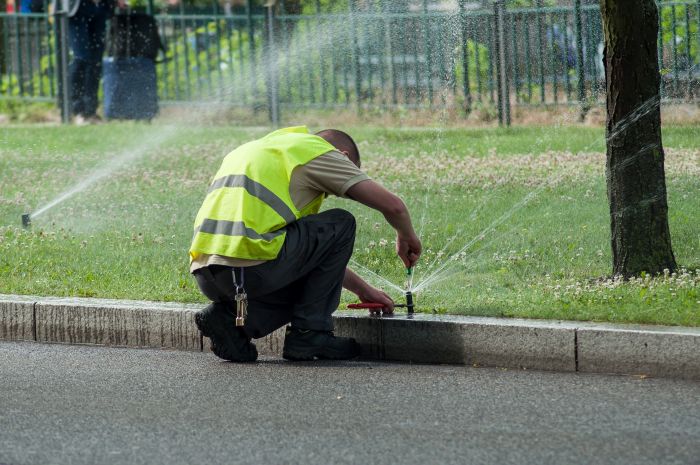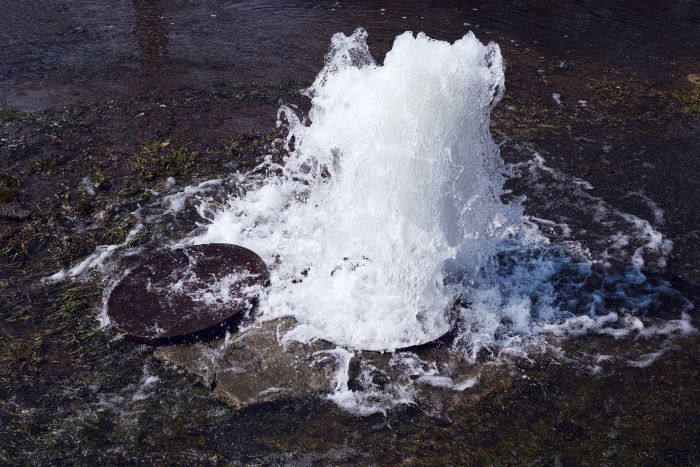
Imagine winterizing a system at a busy retail customer’s location and breaking a mainline in front of the store’s main entrance on a Friday afternoon while blowing out the system.
System blowouts sound straightforward—connect an air compressor, then run each zone until you see a fine mist from the heads. But doing it incorrectly can damage system components, leading to costly repairs or potential injury.
5 winterizing mistakes to avoid
1. Using too much pressure.
Adequate pressure is necessary to ensure water is evacuated from the system, but too much pressure can damage pipes.
“Everybody thinks they need to use 120 pounds of pressure, but the higher the psi, the greater the friction, and that leads to damage,” said New York-based irrigation consultant Jim Navarra. “60-70 pounds is more than enough to empty the system enough to then run each zone.”
He noted that cubic feet per minute (CFM), a measure of how much air a compressor can deliver at a set pressure level, matters more than psi. He recommends maintaining 60-70 psi and 130 cfm to reduce damage and move water out of the lines.
2.Making an unsafe connection to the air compressor.
Choosing an air compressor connection point is critical to safety. Navarra has observed inexperienced technicians making connections on commercial sites with heavy pedestrian traffic.
“The proper spot to connect should be a coupling valve somewhere in the middle of the field or at the end of the system so that in the event a pipe is blown up or a hose breaks, it’s not flopping around under extreme pressure where people can get hurt,” he said.
He also recommends using a steel Chicago-style quick coupling to connect the air compressor hose to the quick-coupling for safety.
“Using a threaded Chicago-style quick coupling has a spot for a safety latch so they can’t come apart,” he said. “I’ve seen a lot of contractors use poly fittings and those are only rated for 100 psi and can melt or break easily under high pressure.”
3. Starting the compressor before opening valves.
Before turning on an air compressor, it’s critical to manually open at least one or two zone valves to give air a path through the system.
“On a recent job, a second-year technician relied on the controller to open the valve, but the valve did not open,” Navarra said. “Pressure built up in the line, blowing out a four-inch mainline at the entrance to a very busy retail store.”
4. Rushing the process.
Time is money, and getting in and out of a site efficiently is essential to maintaining margins. But cutting time on site to fully drain a system can damage components and strain relationships with property managers.
After running and disconnecting the air compressor, Navarra recommends running each zone twice. Run the first cycle for about three minutes, pause briefly and then run the second for about two minutes or until you see a fine mist coming out of the heads. For example, a recent 42-zone winterization took just under four hours to complete.
“An air compressor will only evacuate 60%-70% of the water,” he said. “Running the zones twice allows for air space to minimize damage due to freezing.”
5. Leaving the site without flagging maintenance issues.
Shutting down a system is the ideal time to walk each zone and note any broken heads or other issues.
“Taking notes helps you know where to start with repairs in the spring rather than wasting time,” he said.
Winterizing residential systems
Generally, residential system winterization follows similar procedures, but be mindful of the pressure you’re putting through the lines with an air compressor.
“Most residential systems operate under 100 psi, so it’s particularly important to use the right psi on the air compressor,” he said.