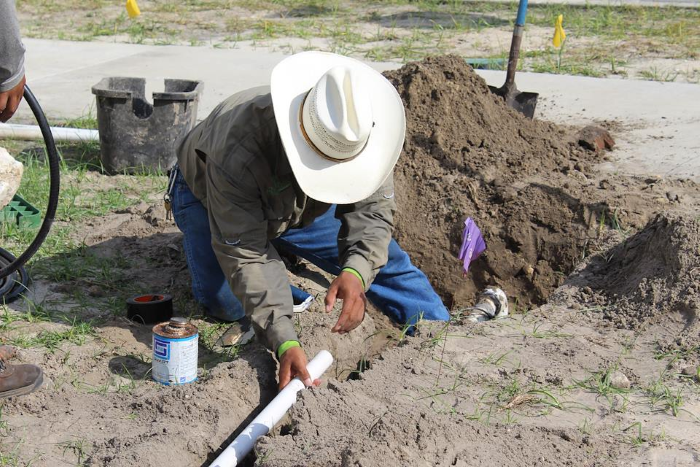
Installing irrigation pipe, holding fittings while glue dries and bending to make repairs put workers in awkward positions, sometimes for long periods. While these physical demands are part of the job, University of Florida researchers are studying practical, non-medication strategies that can help irrigation and landscape workers reduce strain and manage back pain.
“One of the more challenging tasks is laying pipe for irrigation because sometimes people have to work in twisted positions,” said Kim Dunleavy, PhD, a clinical professor and director of community engagement in the University of Florida College of Public Health and Health Professions Department of Physical Therapy, who leads the project. “However, I think what came out of the study offers some possibilities.”
For irrigation contractors already struggling to recruit and retain employees, back pain can compound workforce challenges by contributing to absenteeism, reduced productivity and worker turnover.
Now in its third year of a four-year project, the research focuses on the broader nursery and landscape, including irrigation workers. It builds on earlier research involving plant aquaculture workers in Cedar Key, Florida, and is being done in collaboration with the Southeastern Coastal Center for Agricultural Health and Safety and the Florida Nursery, Growers and Landscape Association (FNGLA).
“The Florida Nursery and Landscape Association approached the center and wanted help because they had people who mentioned the opioid crisis,” she said. “One of my co-investigators had done a survey and identified companies that had workers with problems or new people with problems, and so we merged the two to look at prevention through feasible non-medication strategies.”
According to the World Health Organization, low back pain is the most common musculoskeletal disorder and leading cause of disability worldwide. It can affect workers’ physical and mental health, employment and quality of life. Workers in physically demanding occupations rely on their bodies to make a living, and healthcare can be prohibitively expensive, making prevention and self-management essential.
“We did a number of interviews with owners, managers, experts and workers, and a lot of them accept that pain is part of the job and ignore it,” she said.
4 strategies irrigation professionals can use
Researchers started with one goal—to make the strategies practical and simple so workers would be more likely to include them in their daily routines. Some exercises could be performed at home, while others could be done at the jobsite using available equipment, such as rakes.
1. Stretching and changing positions. Many workers are strong but have limited flexibility in the spine, shoulders or legs. Stretching can help counter the effects of positions workers hold for long periods. For example, after bending forward, workers can reverse that posture by extending the spine.
“Just moving the back helps decrease muscle spasms and actually reduces pain,” Dunleavy said.
2. Strengthening. Building or maintaining core and upper-body strength can help workers handle the physical demands or irrigation installation and maintenance. Dunleavy recommended planks, push-ups, squats and small sit-ups.
“Squats can also reinforce safer lifting habits by encouraging workers to use their legs,” she said.
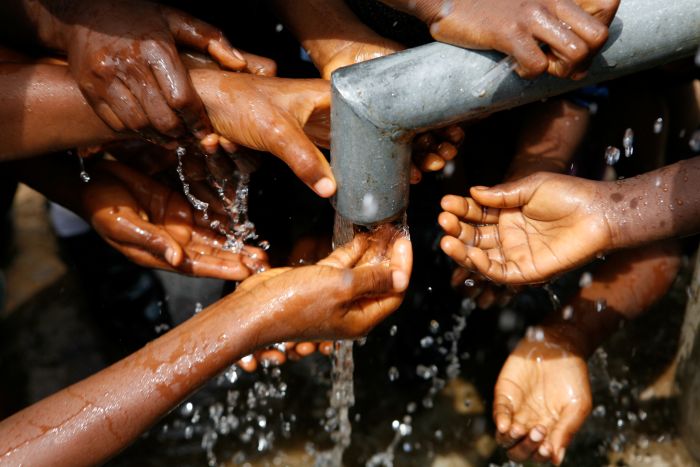
3. Eating and hydrating. Irrigation, nursery and landscape work is physically demanding and often performed during warmer weather. Dehydration and poor nutrition can contribute to fatigue making physically demanding tasks more difficult and potentially increasing the risk for injury.
“If you don’t have the physical energy to do what you need to do, it creates a cycle of potential injuries,” she said. “This is not something that would typically come out of a clinical setting, but it came up in our interviews and the participants really liked knowing how hydration and nutrition could help manage back pain.”
4. Practicing breathing techniques. Most participants recognized that stretching or aerobic activities are helpful strategies for managing back pain, but were unaware of how deep breathing exercises can help manage intense pain.
“Breathing in for four, holding and out for four, in what we call box breathin
Turn awareness into action
Researchers developed short informational videos, some of which discussed the long-term health risks of using over-the-counter medications like ibuprofen and acetaminophen, as well as how to prevent opioid use and manage pain in alternative ways.
Other videos showed ways to adjust physically demanding tasks, including proper lifting techniques, equipment or team lifting for heavier loads. Participants also received twice-weekly text messages over 10 weeks reminding them to use strategies they selected.
“We are in the process of looking at the results right now, but one of the interesting parts is that even without intervention, there was a slight decrease in work task pain, which I think is probably because they were thinking about it more,” she said. “So, increasing awareness within the workplace and providing reminders if they saw somebody lifting too much helped.”
Many of the strategies are not new; workers may simply need reminders and workplace support to use them.
“Occasionally setting up discussions where people can share what has been effective for modifying a particular work task to accomplish it without pain makes a big difference,” she said. “Giving permission for people to actually take just a micro break, a few seconds, just to reverse a position, so people don’t feel like they have to be bending over for two hours at a time or changing tasks.”
Researchers hope to make the videos more widely available in the future and encourage irrigation company owners and managers to consider how they can use reminders to help workers reduce back pain.
“Group text messages can be a good strategy, and we even had one group consider putting videos and reminders in their time tracking app,” she said. “Most importantly, they have to be practical options and workers need to feel supported to use the strategies.”