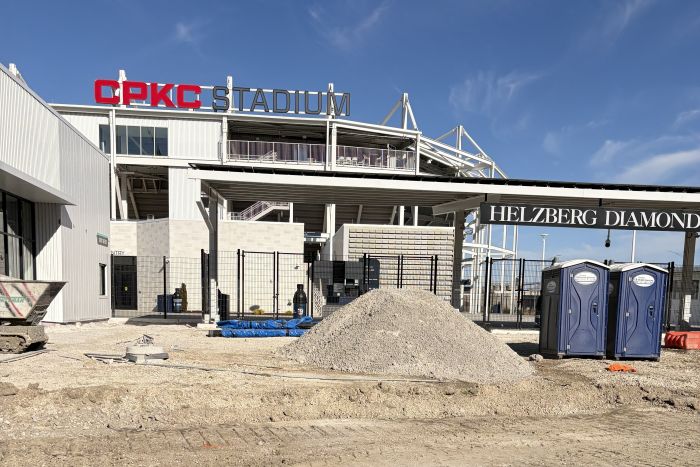
When Kansas City hosted 2026 FIFA World Cup matches, much of the attention focused on the Arrowhead Stadium playing field. But for Richard Thomas, CID, CLIA, vice president of Westland Landscape Co., Inc., critical irrigation and landscape work was occurring blocks away at the CPCK Stadium, the first to be built specifically for women’s professional soccer.
The high-profile riverfront project is a multi-million-dollar, multi-phase development designed to create a mixed-use district with residential, retail and dining surrounding the CPKC Stadium. For the 2026 FIFA World Cup, the area was selected to host the Argentinian soccer team.
Crews working on various stages of the project, both leading up to the team’s arrival and throughout their stay, had a lot to manage while striving to meet installation deadlines.
Here, Thomas shares a behind-the-scenes look at some of the unique scenarios that unfolded and the complexities that come with managing a high-visibility project amid the added challenges of a prestigious international sports event.
Working around a World Cup team
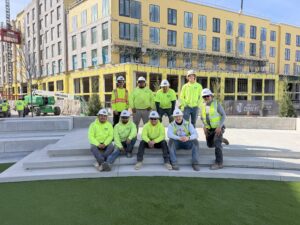
During the World Cup, Thomas had crews working steps from the hotel where the Argentinian team was staying. Coordinating a construction site alongside the team’s movements required flexibility.
“There were times when the site was shut down, and we had to hold off work for a few hours,” he said. “On game days, we had to evacuate the site so that traffic could get through.”
That made weekly in-person and virtual coordination meetings critical to ensure the work was completed on time regardless of the disruptions. It was not an eight-hour-a-day work schedule—some subcontractors worked 15-hour days to complete their portion of the work, according to Thomas.
“Many big projects require coordination; this one has taken it to another level,” he said. “Instead of a single superintendent overseeing the whole job, there are a lot more people involved.”
Crews had to be ready to jump into action once work could resume when the contractors ahead of them finished their work. One example he shared was coordinating with the concrete contractors.
“The concrete crews were moving so fast that sometimes we only had an hour between them doing the cuts, installing and grading our sleeving before they started prepping for the concrete work,” he said. “We had to put a lot of labor on site. It’s not the most efficient way to deploy labor on paper, but it’s what you need for this type of project.”
Five systems in one site
The site includes two apartment buildings, multiple rooftop landscapes and a central plaza, rather than a single irrigation system, the specs required that the irrigation be installed as five separate systems.
“There is one irrigation system for the entire plaza area, one for each of the apartment buildings and an individual sprinkler system for each rooftop area,” he explained. “Even though there is only one owner now, we had to set it up so if they sell the project, there is an irrigation system for each part that could be sold off.”
The project’s riverfront location added a layer of complexity: soil replacement across multiple conditions—walkways, planters, and rooftops. The crews had to excavate all the soil, dispose of it off-site, and bring in three different specialty engineered soils for use underneath paved areas, in planters and on the rooftops.
“The specialty soils under the walks and patios were designed so that when they plant the trees and the planters, the roots have room to expand underneath the concrete and don’t get choked out like they tend to do in many other shopping areas,” he said.
The irrigation design also had to account for the unique soil composition and the demands of rooftop landscapes, where soil depth, drainage and water management differ significantly from ground-level installations.
“This irrigation system for its size was very complex with all the individual zones for the planters, landscape beds, turf areas and rooftops,” Thomas said. “It was very important to get the proper sleeving to all the landscape beds along with the planters throughout the site.”
A look ahead
Although the World Cup brought international attention to the development, work on the site is far from finished. Thomas expects the next phases to build on the same collaborative approach that helped crews navigate one of the project’s busiest periods.
“They just announced another billion-dollar expansion adjacent to the one we’re doing now and a $3 million expansion to the project we’re on now,” Thomas said. “It’s been neat to work on from specialty soils, planters and pavers with the irrigation, and we are looking forward to continuing our relationship with future phases.”
Photo credit: Westland Landscape Co. Inc.