When the Town of Queen Creek in Arizona began planning a new 85-acre park, town leaders knew sustainable water management would be central to the design. Building acres of irrigated athletic fields and recreational areas in a challenging desert environment requires balancing community expectations with sustainability goals.
“The biggest challenge today is that people still look at parks and believe that green is a sign of health, quality and many other benefits,” said Adam Robinson, the director of parks and recreation for Queen Creek. “We knew we had to be really smart about water use while delivering a park the Queen Creek community will love.”
Led by J2 Design in partnership with the Town of Queen Creek and a multidisciplinary project team, the park demonstrates how irrigation design, water reuse and collaboration can help municipalities create large public landscapes while meeting water conservation goals. The team designed and built the entire facility in just 18 months—an aggressive timeline for a project of that scale, especially since construction occurred simultaneously with design rather than in phases.
The project’s success earned the Irrigation Association’s 2026 Vanguard Award in the landscape category; the first landscape project to receive the award since 2018.
“It’s an incredible award,” Kevin Wallin, CID, CIC, CIT, & CLIA, senior associate and irrigation manager for J2 Design. “We were thrilled and excited about the recognition for the effort and work that’s been put into this park.”
Here’s a look at the design decisions and water-management strategies that contributed to the project’s recognition as an award winner.
A sustainable irrigation design
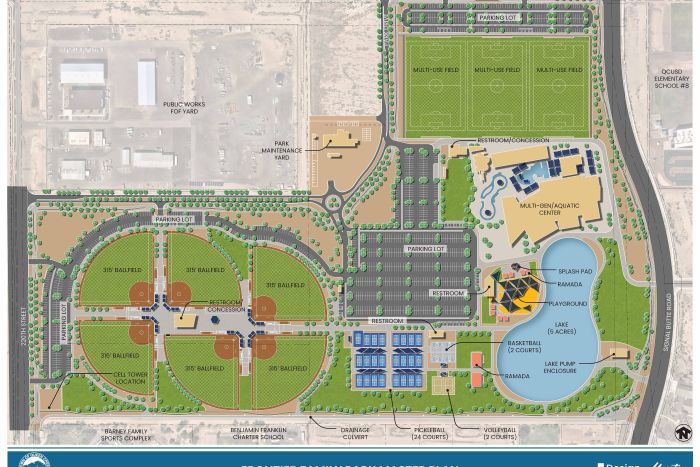
Designing a comprehensive irrigation network for a park this large required a tailored approach to fulfill the Town’s technical specifications. The final irrigation system uses conventional wiring across all six ball fields, three multi-use fields, volleyball courts, a recreation and aquatic center, and acres of turf, ensuring the infrastructure aligns with the Town’s long-term maintenance needs.
Two controllers handle a combined total of 233 stations that manage over 80,000 linear feet of drip line, 72 sprays used to wet down ballfield bullpens only and 1,014 rotors across the entire complex.
“One of the more challenging aspects was the request to use a conventional wiring system because typically we would use a two-wire system on a park this size,” Wallin said.
The design team worked within that requirement while also designing a system that could isolate problems rather than having a single failure affect the entire irrigation system. To accomplish that, they established five separate control areas with multiple flow meters to catch and isolate problems early.
“We included multiple points to monitor water flow as it exits the pump station and within the master mainline and multiple loops,” said Aaron Hendrickson, CID, an irrigation designer at J2. “This way if something were to break or go down, the town does not have to shut off the water to the entire park.”
An innovative approach to the water source
The irrigation system was only one component of a larger water-management strategy. The team also needed a sustainable water source. Queen Creek participates in a shared water treatment arrangement with nearby communities, including the Town of Gilbert.
“We have a shared water treatment facility with a couple of other nearby cities, and that we all pay for,” Robinson said. “But we realized that a system to pump treated or effluent water back here to Queen Creek would have been prohibitively expensive.”
Instead, the communities use a credit-based approach that allows Queen Creek to receive credits for using reclaimed water Gilbert puts into recharge basins. Water moves from an on-site well to fill a five-acre lake which serves as a storage source for irrigation water. A concrete wet well is connected to the lake where a 1,500 gallon per minute vertical turbine pump station draws and discharges the water to the irrigation system.
“A secondary benefit to using reclaimed water is that the lake becomes the water’s holding source, creating a place for fishing, an additional recreational amenity,” he explained. “We also drain our splash pads into the lake instead of draining it to the sewer and wasting it. It helps us meet our Town Council’s goal of having multiple uses for every drop of water.”
In addition to sustainability, maintaining water quality was a priority, especially in Arizona’s high heat climate. Hendrickson explained that irrigation design is tightly integrated with lake health through a recirculation loop with jets placed about 100 feet apart to keep water moving and avoid stagnation and algae issues.
“You always want to keep the water moving because stagnant water will get nasty quick out here in the heat,” he said.
A collaborative approach to an award-winning project
Designing and installing these interconnected systems within an 18-month design and construction schedule required close coordination among the town, designers, contractors, utilities staff and the park maintenance employees.
“We select vendors who have a history of strong teamwork,” Wallin said. “It’s important to have teams that are all in it for the same purpose, and that’s really what we had here with this group. The J2 team specifically is always looking for ways to solve these kinds of issues and come up with creative solutions that really work.”
Wallin and the J2 design team involved the Town’s maintenance crews and utilities staff, bringing the people who would work with the irrigation and landscaping every day into the design process. For Frontier Family Park, the team went further, setting aside nearly a full day to meet with maintenance crews and understand how they would work within the finished park. Designers asked about equipment, mowing practices, and maintenance routines so they could incorporate those operational realities into the irrigation and planting plans.
“Understanding their mower widths allowed us to make sure that all our trees were 10 feet off the sidewalk so they could easily fit their seven-foot-wide mowers in the space,” Hendrickson said. “Their maintenance and mowing practices were factored into every part of the design.”
A sustainable park for today, and the future
Achieving sustainability on any size project, but especially large-scale projects, depends on design, collaboration and innovation to create a system for today and into the future.
“Towns don’t have the money to redesign parks every 10 or 15 years,” said Wallin. “We always design with the future in mind so that whatever we construct today is there and working for 20 plus years.”
While visitors see the green grass, recreational lake and plants, they often take for granted the infrastructure that delivers on the aesthetic. And rarely do they consider the work behind the scenes between multiple teams and the dedication to water conservation.
“Winning the Vanguard Award is reaffirming of the fact that we all put our heart and soul into this work,” Robinson said. “A lot of times, especially with irrigation, it is underground and not visible to the general public, so it’s fulfilling to have all of that work be recognized.”