Navigating the tightrope between municipal water restrictions and client demands for pristine, green landscapes demands a fundamental shift in how irrigation professionals approach their craft.
This is no easy task, considering that this summer, more than half (58%) of the contiguous United States was actively in a classified drought status, according to the National Integrated Drought Information System (drought.gov). The footprint across the U.S. as of June 1 is immense, with 45 of 50 states experiencing drought conditions, affecting roughly 156 million Americans, according to government estimations.
While there is no central federal database that tracks every municipal water-use code in real time, it is estimated that hundreds of water districts and municipalities across the nation have implemented some form of mandatory conservation measures to protect dwindling reservoirs and make the most of a low winter snowpack.
Stringent water and irrigation compliance requirements make efficient water budgeting a necessity rather than an option while irrigation pros attempt to meet customer expectations for healthy landscapes.
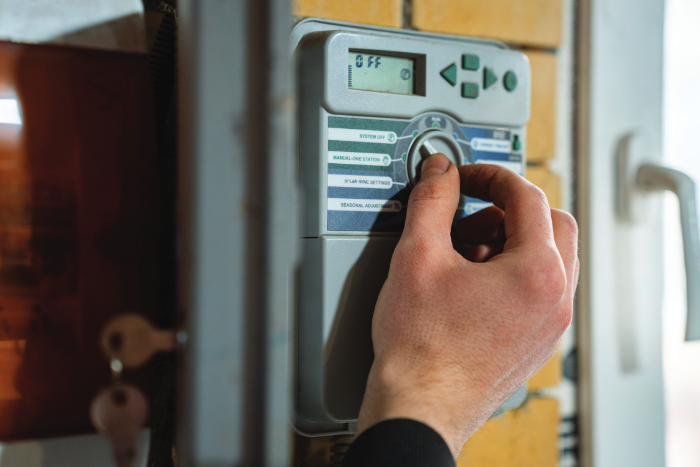
Prudent oversight is not achieved by standing in front of a traditional irrigation controller, says Eddie Duvall, irrigation director at Orlando, Florida-based DVI Water Management, which specializes in designing, installing, and servicing commercial and residential irrigation systems.
While he champions the use of smart water technology — such as evapotranspiration (ET) controllers, flow meters, master valves, soil-moisture sensors and rain sensors — to monitor landscape conditions remotely and manage water budgets through data-driven insights, Duvall believes property owners and managers frequently lean too heavily on this technology as a silver bullet for water conservation and plant health.
These modern irrigation system upgrades are useless if basic field mechanics and maintenance are neglected. Often, a critical gap exists between the capabilities of advanced irrigation technology and its practical execution on clients’ properties.
“[Contractors] install soil-moisture sensors, rain sensors, all this [technology] to collect data to tell us the condition of the landscape from a remote place without having to go out there,” Duvall says. “All of this tech works really well, but what’s happening is technicians and irrigation managers really don’t understand the correlation of distribution uniformity, root zones, precipitation rates, etc., and what these systems have basically become is glorified controllers in somebody’s office.”
Instead of allowing the system to operate dynamically based on live environmental data, Duvall says, operators frequently disable the automatic, ET-driven functions, falling back into a “set-and-forget” mentality, manually programming fixed run times, such as 20 minutes for sprays and 40 minutes for rotors, which defeats the technology’s intended purpose.
To exacerbate the issue, Duvall says the traditional approach to commercial irrigation inspection and compliance is structurally flawed, creating unnecessary delays and inflated costs for property managers.
For example, some irrigation maintenance providers upsell clients on expensive smart systems that promise drastic water savings, only to deactivate the features because staff lack the time to monitor flow rates and system alerts. Worse yet, field maintenance crews may overlook or ignore system leaks, nullifying any advantages the technology offers, he adds.
“I manage systems but don’t do maintenance in the field,” Duvall says. “As the water manager, I’m getting alerts telling me that there’s a mainline leak. I send it to the [maintenance] people, alerting them to go fix the issue, but they don’t. Then, after about seven weeks, I get a call from the property manager wanting to know why his water bill is so high.”
To bridge this operational gap, Duvall proposes a shift from inspection-based to comprehensive repair-based contracts to eliminate the administrative bottleneck. He argues that by bundling routine inspections directly into labor-inclusive maintenance agreements, irrigation technicians can identify and immediately fix system vulnerabilities, such as faulty controllers, broken mainlines and valve replacements, without waiting for approval.
“There is no wait process, there is no estimating, there is none of that,” he says. “Go out, inspect the property and fix everything that needs repair.”
Duvall adds that prioritizing foundational repairs, such as straightening misaligned heads or sealing mainline leaks, can help an irrigation system achieve 60%–70% distribution uniformity. This ensures equal water application across entire zones and slashes necessary run times from 20 minutes down to just six or seven minutes, delivering true sustainability through mechanical precision.
By understanding local water restrictions, professionals can align system parameters to respect regulations and still fulfill the client’s landscaping needs.
Education is critical
Balancing strict municipal water restrictions with property owner demands for green landscapes remains a major hurdle for modern irrigation professionals as drought conditions persist and worsen. A cornerstone in solving this dilemma is rigorous contractor education, says Brian Vinchesi, CGIA, CIC, CID, CLIA, CLIM, CLWM, an irrigation industry veteran and educator and the president of Irrigation Consulting in Nashua, New Hampshire.
Too often, according to Vinchesi, professionals in landscape installation lack a deep technical understanding of modern irrigation design, and this results in inefficient systems that undermine potential water savings from the get-go.
“Unfortunately, a lot of people who do these [commercial and residential irrigation installations], especially on the landscape side, don’t know a lot about irrigation, and they kind of just throw them in and do it inefficiently,” Vinchesi says. “If you do it inefficiently, you’re not going to save any water.”
To truly balance conservation with aesthetics, contractors must thoroughly familiarize themselves with modern products and master the underlying technology. This requires education, Vinchesi says.
“I’ve seen a lot of people put in smart [irrigation] controllers that then get ripped out because the maintenance contractor doesn’t know how to use them and they’re scared of them,” Vinchesi says. “So, education is a big deal.”
This extends beyond contractor know-how, he says, adding that professionals must take the time to educate their clients not only on advancements in irrigation technology, but also on the water restrictions at play within their community.
“There are a lot of regulations out there, and many of them are good,” he says. “For example, there are 12 states that require pressure-regulating spray sprinklers, and this is a great idea. But there are some [irrigation professionals] in the industry who argue that this is overkill, that it’s not necessary on every system if you have lower pressure. However, the vast majority of systems operate at pressures well above those required by a spray head.
“So, that technology can help, but it only helps if you know it exists,” Vinchesi adds.
However, he emphasizes that impactful education does not require advanced, high-tech irrigation systems. Instead, he says, massive improvements result from mastering foundational concepts.
For instance, many property managers and homeowners fail to realize that rotor heads distribute water five times slower than spray heads. When contractors don’t explain these basic precipitation rates, end-users routinely set identical run times for entirely different zones, leading to massive water waste.
Balancing expectations
For irrigation professionals, transitioning from basic service provider to trusted partner is absolutely critical for an irrigation system’s long-term success.
Homeowners and property managers inherently look to their contractors as a premier, one-stop resource for answers and solutions. To fulfill this role, it is essential to equip contractors with comprehensive system knowledge and work cohesively with them, says Don Chouinard, a 33-year veteran irrigation contractor and principal pro account manager at Edina, Minnesota-based Irrigreen, which specializes in smart sprinkler systems.
By understanding local water restrictions, professionals can align system parameters to respect regulations and still fulfill the client’s landscaping needs. Ultimately, this partnership thrives on thorough, proactive communication, Chouinard says.
It boils down to two main factors. First, homeowners are typically already well aware of their local watering restrictions. Consequently, their initial inquiry with their irrigation partner focuses on scheduling flexibility, specifically whether the system can be programmed to comply with strict odd/even calendar days or specific designated days, Chouinard says.
The second major point addresses a systemic flaw in traditional irrigation design. Chouinard says conventional systems rely on rows of lateral sprinkler heads that frequently overshoot, spraying water past the grass and directly into the street.
He recommends placing the sprinkler heads in the center of the lawn. By spraying outward precisely to the edge of the property line, the system prevents the typical back-spray and oversaturating runoff that plagues standard installations, directly resolving the industry’s widespread issue of water waste.
Often, meeting client expectations has less to do with where water is placed and more to do with how it is applied. Therefore, it’s equally important for professionals to take into account the property’s overall makeup, Chouinard adds.
“You can’t just throw water down on grass without knowing what type of grass you’re dealing with — fescue, bluegrass, St. Augustine — because they all have different watering requirements,” he says. “And you need an understanding of property basics, like what areas get full sun versus shade and whether you are dealing with clay or sandy loam soil. All of those [points] will factor into how much water you should be putting down to make sure you get the greenest, healthiest landscape, because every client’s property is different.”
Programs for professional improvement
Learning opportunities abound for irrigation contractors willing to invest time in professional improvement. According to Brian Vinchesi, president of Irrigation Consulting in Nashua, New Hampshire, most major manufacturers of residential and commercial irrigation components, such as Rain Bird and Hunter, offer educational resources, and specialized independent firms provide high-quality training.
Likewise, professional organizations like the Irrigation Association offer institutional coursework, Vinchesi adds, noting that he serves as an IA instructor. IA University courses teach core curriculum, ensuring irrigation professionals have the fundamental and practical skills to design, install and maintain an irrigation system. These courses are taught in person at the annual Irrigation Show and Education Week and virtually during Landscape Irrigation Pros Week held each spring. Registration is open for courses at the 2026 Irrigation Show, Dec. 7–10, in Las Vegas. Go to irrigationshow.org for more information and to register. Registration for Landscape Irrigation Pros Week will open in early 2027.
Additionally, Vinchesi advocates formal licensing and certification programs that compel contractors to meet baseline competency requirements. He highlights the Qualified Water Efficient Landscaper, or QWEL, program as an excellent, highly accessible stepping-stone.
QWEL is designed to train landscape professionals in sustainable, water-efficient practices, particularly in the western U.S. It is a recognized WaterSense-labeled program focused on reducing landscape water demand through improved irrigation management, soil management and plant selection. QWEL offers a 20-hour training workshop covering topics such as sustainable landscaping, irrigation auditing and controllers. The workshops are usually free or low cost.