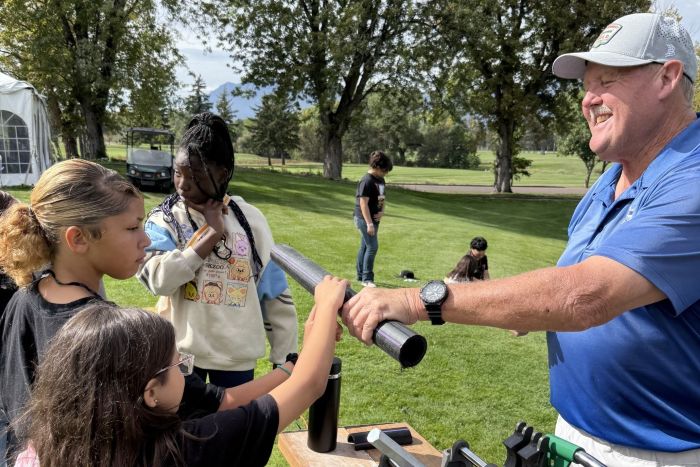
For nearly 30 years, a unique field trip program has connected K-12 students to golf courses as part of a workforce development initiative that introduces them to career opportunities in the industry. First Green began in the Pacific Northwest in 1997, and GCSAA assumed leadership in 2018. Since 2018, more than 30,000 youth representing all 50 states and Canada, the U.K., Australia and Pakistan have participated in a field trip.
“A lot of students have never even set foot on a golf course, let alone know the careers, skills and knowledge that it takes to produce those landscapes,” said Erin Wolfram, director of the First Green program, which is overseen by the Golf Course Superintendents Association of America (GCSAA).
A living learning lab
First Green field trips typically last two to three hours and are built around four to six hands-on learning labs that directly connect golf course practices to STEAM (science, technology, engineering, arts and mathematics) school curricula.
GCSAA members host the events, and golf course superintendents and their planning teams have access to fully designed lesson plans aligned to school standards. Topics range from wildlife habitats to soil science, environmental sustainability, mathematics, water conservation, water quality, career exploration and more. At least 15% of field trip hosts who have submitted feedback about their learning labs have included a water conservation station.
“Not all hosts complete the feedback form, so this only represents those who completed the form,” Wolfram said. “Others hold additional associated learning labs related to irrigation, water quality and environmental stewardship as well.”
For example, a field trip held at the Patty Jewett Golf Course in Colorado Springs, on Sept. 17, 2026, explained the process behind recent upgrades to the irrigation system.
“They talked about irrigation and showed students how pieces of pipe are fused together for the pipe path,” Wolfram said. “Students even got to turn on the irrigation for a specific area of the course via an iPad.”
Youth groups like Girl and Boy Scout troops, 4-H, FFA and similar organizations can also participate if a GCSAA member is interested in hosting them. To increase accessibility, GCSAA provides grants of up to $500 to support each event.
“Our hope is that there isn’t a financial burden on the host or the school/youth organization,” she said.
Teaching sustainability
Beyond workforce development, First Green serves a broader purpose—helping reshape public perceptions about golf courses, water use and environmental impact.
“Sometimes golf courses get a bad rap, and people think that they’re not environmentally friendly,” Wolfram said. “First Green is another way that we can introduce folks to what’s happening on the golf courses and how they are helping the environment.”
Through the learning labs on water conservation, wildlife habitat and environmental stewardship, students and their teachers or youth leaders see firsthand how irrigation practices, water-management technology and turf management can support sustainability goals.
Planting a seed
Students might just view the day as a fun break from the classroom. But for the golf industry—and irrigation professionals—it is an opportunity to plant a seed with the next generation of industry leaders.
“It is our goal to introduce youth to exciting career opportunities through a fun and educational day on the golf course where they can apply the skills and knowledge they have gained in the classroom through experiential learning labs,” Wolfram said. “While many of the students may not choose a career in golf course maintenance, after participating in a field trip we hope they have a better understanding of what goes on behind the scenes and how golf courses are benefiting their communities.”
GCSAA members who host First Green field trips often welcome volunteers to support the event, including those interested in hosting a learning lab specifically focused on irrigation. To learn more or to volunteer, email firstgreen@gcsaa.org.