Water reuse systems are moving from niche sustainability system to practical infrastructure across residential and commercial landscapes.
In mid-April, the U.S. Environmental Protection Agency announced its launch of the Water Reuse Action Plan, or WRAP, 2.0. The plan aims to harness the power of water reuse for American industry, artificial intelligence and energy dominance while strengthening public health protections and safeguarding the nation’s water resources, according to the agency. The plan focuses on:
- Supporting reuse for domestic industry, including for component fabrication (such as bottles and batteries), finished products (such as food and beverage items), and in vehicle and agricultural production.
- Providing water for the U.S. “technology revolution,” including for microchip and memory fabrication and data center cooling.
- Unleashing American energy dominance through electricity generation and energy development.
Meanwhile, Ben Glickstein, director of communication for the WateReuse Association, a trade association dedicated to advancing laws, policy, funding and public acceptance of recycled water, notes that on-site and municipal water reuse systems are becoming increasingly important for commercial irrigation.
Benefits are plentiful
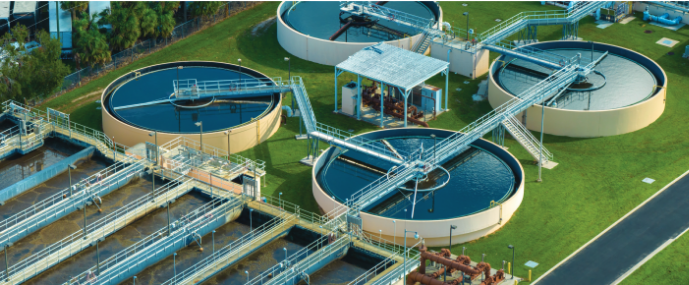
On-site water reuse refers to collecting and treating stormwater and wastewater for reuse within a building or across multiple buildings for applications such as toilet flushing, irrigation, cooling towers and industrial processes. Alternative water sources for this include graywater (wastewater from sinks, washing machines, etc.), blackwater (wastewater from toilets), rainwater, and stormwater and foundation drainage.
These systems represent a significant opportunity to transform the way water is managed by providing water security for businesses, improving water access for underserved communities and serving as a central component of resilient infrastructure, the organization notes. System benefits also include:
- Providing additional water supply and offsetting demands on valuable potable water, which is especially important during drought periods.
- Managing stormwater, treating wastewater and supplying water for buildings during natural disasters such as floods and earthquakes.
- Efficiently serving customers not easily reached with centralized systems and allowing for infill development in communities where the legacy infrastructure is at full capacity.
- Helping to reduce pollution by diverting runoff and wastewater that could otherwise contribute to flooding, sewer overflows and surface-water contamination.
- Helping to reduce water and sewer bills and alleviate strain on infrastructure, resulting in significant savings for utilities and their customers.
Industrial uses are on rise
There are some restrictions surrounding recycled water used in industrial settings. For example, it must be processed to meet specific standards for its intended end use. In general, there are two ways this can happen: the water can be captured, treated and reused all in the same facility, or it can be supplied through public-private partnerships in which municipalities provide industrial facilities with treated recycled water.
According to the WateReuse Association, industrial facilities adopt water reuse for a variety of reasons:
- As persistent drought, increasing demand and other pressures strain local freshwater resources, it offers a reliable option for facilities that depend on water to operate.
- Recycled water is often less expensive than water treated to drinking-water standards because of the reduced treatment costs.
- As state and local governments increase water-quality regulations, water reuse can help achieve regulatory compliance. Several jurisdictions even stipulate recycled water use for new plant construction.
- Reuse can support an organization’s corporate vision and environmental stewardship goals by promoting sustainability and resilience and lessening impact on local water supply.
Another benefit of water reuse is that, in some cases, it’s actually a better option. Commercial, institutional and industrial facilities rely on large quantities of water for cooling, washing, processing, conveyance, energy production, sanitation and irrigation. In fact, upward of 50% of total commercial water use is for cooling equipment.
For these uses, potable water is not required. That means companies can take a fit-for-purpose approach, selecting a custom combination of water treatment technologies that supports their processes and avoids costly over-treatment.
This is just one reason the adoption of recycled water is expanding with a range of industries, including power generation, mining and metals, pulp and paper, microelectronics and data centers, and biofuel and alternative fuel plants. Other industries putting it to use include food and beverage, pharmaceutical, automotive, textile, and oil refining and petrochemical.
“In some cases, harvested rainwater and graywater could be distributed via the same set of irrigation pipes. There is some opportunity for synergies between the two types of systems.”
— Jim George, PhD, professor, Johns Hopkins University
Graywater: from simple to sophisticated
Laura Allen, founder of Greywater Action, which describes itself as “a collaborative of educators who teach residents and tradespeople about affordable and simple household water systems that dramatically reduce water use and foster sustainable cultures of water,” notes graywater is one of several nonpotable water sources that can be used for irrigation, adding that since graywater is generated year-round, it’s often the best source to tap into in dry climates.
Graywater systems range from simple ones a homeowner can install to more complex systems that require professional installation, she says.
For most residential sites, a “laundry-to-landscape” system that delivers water from the washing machine discharge hose is a great way to start, Allen notes, adding that some water agencies offer system installation incentives and rebates. She says graywater codes vary state by state; some states don’t yet have regulations, and in others, no permit is required so long as basic health and safety guidelines are followed.
Allen says “graywater contains organic material and nutrients which can benefit landscape plants — think fertilizer.”
Treatment for dirty water is needed if the water will be discharged into a waterway or reused in a building for toilet flushing or other nonpotable purposes, but “Graywater irrigation systems don’t treat the water — they are designed to prevent clogging of the irrigation parts,” she says. “Simple systems use larger tubing and outlets to avoid clogging, then filter the graywater in the landscape with wood chips.”
A mulch basin filters graywater so it flows into the soil and hydrates plant roots, Allen notes.
Other systems filter the particles out of graywater before it reaches the irrigation system, making it possible to send filtered graywater through special drip tubing, though the filter will need to be cleaned on a regular basis, Allen says. She notes simpler systems require less maintenance and as a result often last longer.
A major irrigation source
Sean Azad, Rain Bird landscape marketing manager, notes, “In most irrigation systems using captured water, the recycled water is usually the primary water source. Potable water is used as a secondary water source.
“The control system needs to support multiple water sources and some type of tank float that monitors the water level of the captured water,” he continues. “It then needs to dynamically switch between water sources based on the water level in the tank.”
Professionals also say people need to remember that graywater use is not the same as rainwater harvesting. Not recognizing the differences can cause issues in places where there is an abundance of rain and in places where the climate is much drier.
Jim George, PhD, teaches water resources management for the John Hopkins University Engineering for Professionals Program. He recently retired from his role as a senior policy adviser to the director of the Water and Science Administration at the Maryland Department of the Environment.
He says arid places, which don’t have the opportunity to do a lot of rainwater harvesting, are “ahead of the curve when it comes to graywater reuse. This is because it is almost always dry during the summer, which reduces complications.”
George notes that in a relatively water-rich state like Maryland, graywater reuse is complicated by a desire to avoid discharging the water onto rain-saturated soil.
“Doing so can lead to the ponding of graywater on the surface, increasing the risk of human and pet exposure,” he says. “This necessitates turning off the graywater system when it rains. While schemes can be envisioned to do this, governments have to consider the realities of people not following those schemes.”
Local governments are then “stuck responding to complaints such as ‘My neighbor’s soapy water is running into my yard where kids play,’ ” George says, adding “for reasons like this, Maryland did not adopt residential graywater regulations despite draft regulations being developed with the assistance of an advisory group.”
A key motivation for the graywater regulations was to reduce water use, which in theory would allow more development in a water-stressed area, says George. “When it became clear the numbers wouldn’t work out to support more development, interest in the graywater regulations waned.”
He notes another key reason for not lumping rainwater harvesting and graywater together is that graywater often contains organic and human fecal matter.
“It is widely advised not to store this water for more than 24 hours to avoid the risk of it becoming putrid,” he adds. “Rainwater doesn’t typically have this storage-time limitation, provided that the first flush is diverted away from the storage container.
“In some cases, harvested rainwater and graywater could be distributed via the same set of irrigation pipes. There is some opportunity for synergies between the two types of systems.”
This practice is most safe when using gravity-flow systems, notes George.
“When pumps are involved, there can be a risk of the graywater getting pumped into the rainwater system and contaminating it,” he adds. “This isn’t a huge problem unless someone is using it for drinking water, which typically isn’t allowed in the U.S. but is common in other parts of the world.”
More about graywater
Before he retired from the Maryland Department of the Environment, Jim George created a graywater reuse website that examined motivations for water reuse in Maryland and provided case studies about the practice. Find it at mde.maryland.gov/programs/water/waterconservation/pages/water_reuse.aspx.