Overnight irrigation scheduling is a common strategy for reducing water loss from evaporation and wind drift in arid regions. But a new study suggests that avoiding watering during peak wind speeds may be more important than the time of day for conserving water. The findings could give irrigation professionals greater flexibility when scheduling run times while maximizing water use, especially as watering restrictions increase.
“Irrigating at night is not a practice to hang our hats on for water conservation,” said Melanie Stock, PhD, an associate professor at Utah State University and co-author of “Paying attention to and avoiding peak hours of the day for maximum wind speed more effectively saves water with sprinkler irrigation.”
Intuitively, the practice may make sense, explained Stock. At night, the air temperature is cooler and there is less wind, so presumably irrigating at night would lead to less water being lost to evaporation and more going to the landscape plants.
“With growing residential demand and peak use consolidated to only nighttime hours, however, concerns arose about system capacity and the question, how much water does this practice save,” she said. “We were stunned to see how limited the research was and set out to test day versus night sprinkler irrigation timing in Utah and with two common urban crops.”
Daytime irrigation offers unexpected benefits
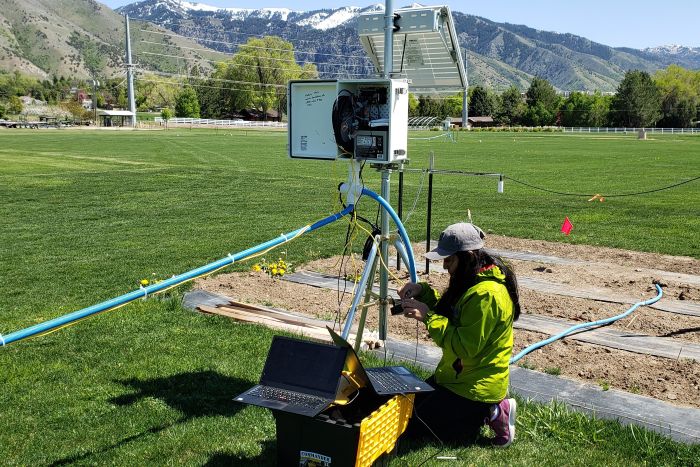
Over three years, researchers compared daytime and nighttime irrigation on turfgrass, specifically Kentucky Bluegrass and zinnias. They measured how much water was applied; how much was lost to evaporation and wind drift, and how much made it into and was stored by the soil. They also monitored air and surface temperatures, humidity around the plant canopy and plant productivity.
The site irrigation system was a solid-set sprinkler system with the heads spaced 50 feet apart in a square-grid pattern. The nozzle sizes ranged from 6 to 16 (4.9 to 12.6 GPM), with rotor arcs ranging from 180 to 360 degrees.
“The most surprising find, at first, was that daytime irrigation had a benefit,” she said. “By irrigating during the heat of the day, the sprinkler irrigation cooled the microclimate—the canopy and surface temperatures decreased and the humidity increased, which gave the turfgrass and flowers a sort of rest from heat stress and reduced evapotranspiration, which was found in early studies of daytime irrigation in corn.”
That cooling effect was less pronounced during nighttime irrigation, when temperatures were already lower and humidity was already higher. Researchers also found greater soil moisture storage, as well as greater crop productivity and quality, following daytime irrigation in both turfgrass and zinnias.
“We attributed this to less water uptake (use) needed by the plants because of the daytime irrigation’s cooling and humidifying effect,” she said.
The findings suggest that daytime irrigation can provide benefits beyond delivering water to the root zone. However, the benefits depend on weather conditions, particularly wind speed.
Use wind speed to inform irrigation scheduling
For irrigation professionals, the study’s most practical takeaway is to avoid scheduling sprinkler run times during peak wind speed periods or forecasted gusts. Stock said this could be done in two ways to conserve water.
1. Avoid irrigation during local peak wind speed times.
“At our study site, this was between 3 and 5 p.m., which opens much of the day to irrigation, rather than day versus night,” she said.
Rather than limiting irrigation to nighttime hours, contractors can review local wind patterns to identify lower-wind periods and schedule systems to run accordingly.
2. Use wind as a skip trigger on smart controllers. “Many controllers connect to nearby weather stations and can skip an irrigation event if there is a certain amount of rain,” she said. “I would love to see high wind speed as a trigger to skip too. Losses were greatest with gusts, but losses were high when average hourly wind speeds were greater than 6.5 mph.”
Although wind conditions vary, many locations experience predictable daily patterns, with higher wind speeds often occurring later in the afternoon. Reviewing local weather data can help contractors identify when sprinkler irrigation is most likely to experience losses.
“Locally, know the hours of the day with the highest wind speeds and advise against scheduling sprinkler irrigation during those hours,” she said. “It was shocking to see the water loss—up to 50% in turfgrass during high wind!”
Daytime irrigation schedules can simplify system monitoring
Scheduling irrigation during the day may also offer an operational advantage—making it easier to spot problems while systems are running. Stock recalled an attendee at one of her presentations who preferred daytime irrigation because it let him keep a closer an eye on a system and adjust as needed.
“When it ran at night, he really didn’t know if there was a problem to fix (e.g., leak, issue with rotation) because he was not awake to notice it,” she said. “I appreciated this consideration too.”
Daytime irrigation may not be practical for every property, particularly retail and commercial sites where watering could interfere with customers, employees or daily operations. However, contractors can use local wind patterns to identify scheduling windows that minimize water loss while accommodating customers’ needs.