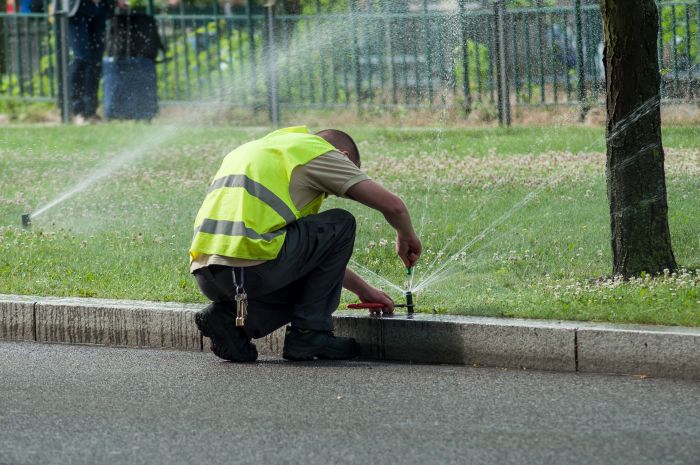
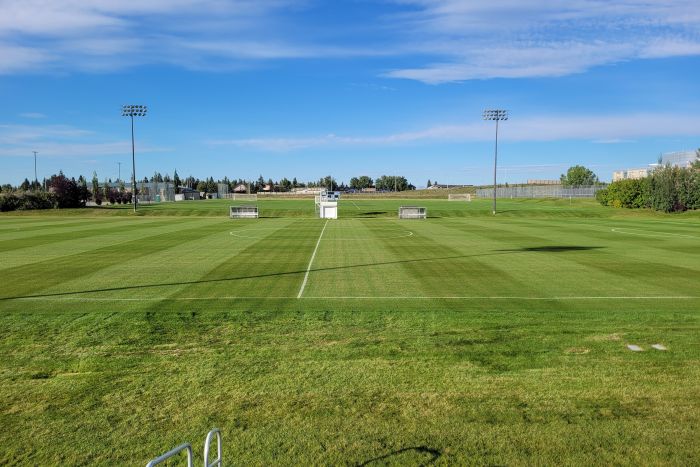
Determining soil moisture is vital for maintaining any kind of plant life, from a backyard herb garden to acres of diverse greenery spanning a park. Too much moisture and plant roots are unable to breathe. Not enough moisture and plants don’t receive enough sustenance.
There are numerous ways to find soil moisture levels, and they range in cost, placement, technology and ability. The most important aspect is figuring out what soil moisture reader matches a user and an area receiving irrigation. Is your land more in need of a soil moisture meter or a sensor?
Moisture meter break down
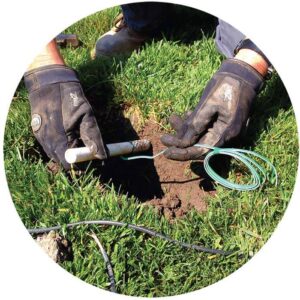
Soil moisture meters are portable devices that can quickly read moisture of different soil locations at different times, says Eric Santos, CGIA, CIC, CID, CLIA, CAIS, CLWM, vice president of irrigation services at BrightView Holdings Inc., Blue Bell, Pennsylvania.
Meters detect electrical currents in the soil by inserting probes into the soil and calculating a percentage of soil moisture content.
“Monitoring moisture with a meter is a way to manage water more efficiently,” Santos says. “Moisture meters will help us identify and correct problems such as coverage, fertility and uniformity issues so that we can improve the health and appearance of a system while using water efficiently.”
When and where a meter is used provides different information regarding irrigation effectiveness, Santos adds. Knowing the soil type, the time of the last irrigation and the amount of water that was applied can help determine the best time to irrigate again.
A user can determine if the soil has reached field capacity by taking readings directly after watering.
A moisture meter can help a user determine if they are putting down enough water in a way that is slow enough using cycle and soak methods to get the water to infiltrate into the root zone by knowing the precipitation rate of the zone and the watering time.
Using moisture readings at two different depths, a user can determine if their irrigation application is percolating beyond the root zone.
Moisture sensors
Soil moisture sensors are permanent underground systems that measure a soil’s water content at the location and depth where it was placed. There are many types of sensors, but in commercial landscape, the most common are tensiometers, granular matrix blocks and dielectric sensors, Santos says.
But where meters provide moisture readings of one location, sensors can be hooked up to controllers where an entire irrigation system can be programmed to meet a soil’s moisture needs.
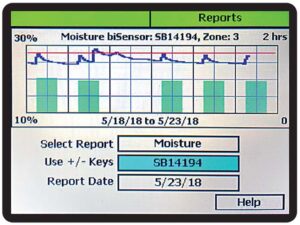
“Sensors measure the moisture within the soil to make sure it’s reaching where it needs to go,” says Forrest Jammer, CLIA, a project manager and landscape architect at Osborn Consulting, Bellevue, Washington. “If the moisture gets to a certain threshold, it will shut everything down. It’s a great on-off switch basically, but it is an effective tool to be able to help manage moisture levels within your soils.”
Sensors can be used in several ways, explains Brian Vinchesi, CGIA, CIC, CID, CLIA, CLIM, CLWM, founder and president of Irrigation Consulting Inc., Nashua, New Hampshire.
One way is to use sensors as a safety. When an area hits a certain amount of moisture, the irrigation system shuts off.
Another way requires the purchasing of an irrigation controller that can handle inputs. While more expensive, the smarter system goes beyond reacting to soil moisture and can measure the soil moisture and provide feedback. A user can program when they want irrigation to turn on when the soil has reached a certain dryness or to shut off when it reaches a certain wetness.
“The more sophisticated it becomes and the more information it gives the controller and the operator, the more precise they can be with the water,” Vinchesi says. “It just makes irrigating smarter, and when you’re smarter, you use less water.”
“The more sophisticated it becomes and the more information it gives the controller and the operator, the more precise they can be with the water.” — Brian Vinchesi, Irrigation Consulting
Meter pitfalls
The largest issue Santos sees with soil moisture meters is landscape professionals having a poor understanding of soils.
“Being able to interpret the readings provided by moisture meters isn’t rocket science, but it’s not intuitive either,” Santos says. “Most beginners think a moisture meter reading of 35% is low, but in a clay loam soil, it’s actually very close to field capacity.”
Another pitfall is that clients can be under the belief that moisture meters will be “the silver bullet” to managing an irrigation system efficiently, Santos adds.
“Even though moisture meters are good at helping you determine when is the next time to water, they don’t tell you how much to water,” Santos says.
To figure out the amount of water needed, Santos says a user must know the precipitation rate of the system, the soil intake rate and the point where runoff occurs. A moisture meter can then be used following an irrigation application to help determine if the water was applied effectively.
Another common mistake is that not all users understand the dramatic differences that can exist in the field capacity and permanent wilting point between different soil types.
Sensor pitfalls
Sensors can function wirelessly, track data over an extended period of time and control irrigation, but to work at their greatest potential, sensors must be installed and calibrated exactly per the manufacturer’s instructions, Vinchesi says.
“You can’t just install them,” Vinchesi says. “You also have to program everything so that they actually do something. You’d be surprised how many we see that were put in but were never calibrated.”
Vinchesi explains that sensors don’t necessarily go in one per zone so users don’t have to purchase an exorbitant amount of sensors. They’re placed in zones with similar conditions — i.e., all zones in sunny areas run off one sensor. While this method saves money, all of the wiring, which can differ with each manufacturer, must be done correctly.
“It’s not an easy install, but it’s not a hard install,” Vinchesi says. “You just have to learn how to do it properly.”
Using a soil moisture reader provides data, but it’s up to the irrigation
professional’s understanding to make that data useful.
When to use meters, when to use sensors
When it comes to deciding whether a meter or a sensor is best for an area of soil, numerous factors go into that choice.
First, is the area able to receive a permanent moisture reader? If yes, a user should consider a sensor.
“There are a lot of different manufacturers that make great sensors that are wireless and can log data over time, which is very useful,” Santos says. “If there is a permanent location for a sensor to be placed and integrated into a controller to help automate the watering process, a sensor should be used over a meter.”
If an area of soil is better suited for a portable solution, meters might be the way to go.
“If temporary moisture monitoring is being used to track trends over a short period of time over many different locations, then a moisture meter would be a more suitable option,” Santos says.
However, Santos advises against using a meter if a user wants to monitor moisture in the exact same location over an extended period of time.
“There are much more efficient ways to do this using a sensor that can log moisture readings continuously over an extended period of time and produce a graph showing changes over time,” Santos says.
Sensors can also be used when landscaping green buildings, Vinchesi says. Using a soil moisture system helps meet LEED credits, Green Building Initiative credits or Sustainable Site credits.
“The irrigation system will pretty much manage itself, and you’re going to save water,” Vinchesi says. “If you’re in a place that has very expensive water, that’s going to certainly help.”
Jammer says that a large factor when deciding on a meter or sensor is a question of control the user wants to have. Sensors can offer an on-and-off switch for an irrigation system, while meters allow for greater jurisdiction over water amounts and times.
“Not every occasion is the right use for sensors,” Jammer says. “It just depends on how much control you really want to have on the system when it comes down to it.”
You have the data – now what?
 An essential use of the data soil moisture meters provide can be used to tell which areas receive less amounts of water, says Eric Santos, CGIA, CIC, CID, CLIA, CAIS, CLWM, vice president of irrigation services at BrightView Holdings Inc., Blue Bell, Pennsylvania.
“Knowing where the areas are with lower moisture readings, or areas with weak coverage, can help in developing a solution to improve the coverage in these weak areas,” Santos says. “Since the areas of weak coverage drive irrigation demand, the more we can do to identify and correct these areas will result in water savings.”
The greatest use of a soil moisture sensor’s data is figuring out how well the irrigation cycle performed throughout a period of time, says Forrest Jammer, CLIA, a project manager and landscape architect at Osborn Consulting, Bellevue, Washington.
For example, after building a site that has been played on by 400 children for a year, sensors can explain how the soil has moved, how things are with compaction and whether the irrigation program has worked. Maybe it was discovered one area drains faster than others on the site, requiring increased irrigation in one area and possibly needing a decrease in another.
“It’s a push and pull that you do with a system over the course of time on a piece of property,” Jammer says. “You’re always adjusting it because something’s changing out there.”
Experiencing and learning how to best use sensors, what to expect when using them, as well as knowing the different sensor model types and their abilities and limitations can help landscape professionals extend beyond traditional outdoor landscaping and into projects like rooftop gardens, green roofs or mid-level amenity spaces in apartment complexes.
“It gives you the opportunity to make some educated decisions on the different areas you can utilize sensors in,” Jammer says. “You are also able to understand that data to be able to communicate it No. 1, to your clients, and No. 2, to potentially other consultants or other installation companies.”