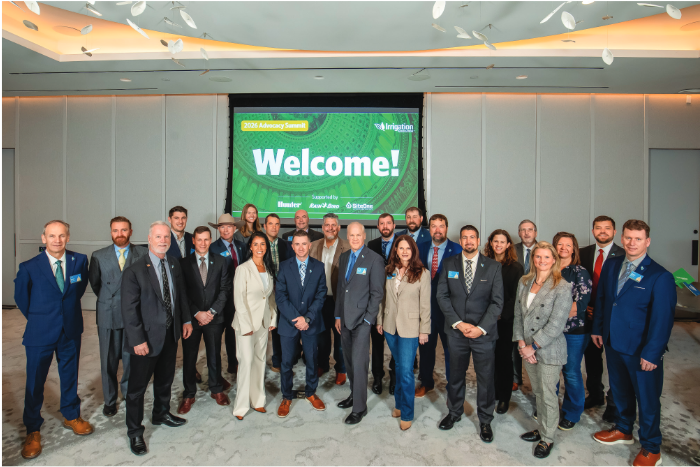
Each spring, the Irrigation Association brings irrigation professionals to Washington, D.C., to meet directly with lawmakers and federal agency staff on the policies shaping the future of landscape and agricultural irrigation. The 2026 IA Advocacy Summit continued that tradition, giving members a chance to bring field experience and technical expertise into conversations on water efficiency, resilience and conservation.
Held March 10–12, the summit gave participants a coordinated way to explain how federal policy affects irrigation contractors, manufacturers, designers and water users on the ground. It also reinforced the industry’s role in helping communities manage water wisely while maintaining healthy landscapes, green space and other outdoor environments people rely on every day.
“This year’s Advocacy Summit was a strong reminder of how valuable it is when the irrigation industry speaks with a unified, informed voice,” says Andrew Morris, IA director of policy and technical affairs. “When policymakers hear directly from people working in our industry every day, it helps them better understand how irrigation contributes to water efficiency, resilience and sustainability.”
Key advocacy priorities
Landscape advocacy priorities discussed during the summit included:
- Supporting the Environmental Protection Agency’s WaterSense program by sustaining funding, keeping specifications current and maintaining the third-party certification infrastructure behind the label.
- Reinforcing that professional competency is as important as product selection, because irrigation performance depends on design, installation, programming, commissioning, maintenance and site conditions.
- Encouraging practical implementation of WaterSense-related policies so state and local requirements do not oversimplify how irrigation systems perform in the field.
- Support stronger federal attention to municipal water reuse for irrigation to offset potable demand and improve drought resilience.
- Backing the broader federal water-efficiency toolkit, including WaterSense, State Revolving Funds, the Water Infrastructure Finance and Innovation Act, and related tax policies that support community conservation and reuse programs.
For agricultural irrigation, discussions centered on the upcoming 2026 Farm Bill, with emphasis on strengthening conservation delivery, supporting precision irrigation and improving access to technical assistance through U.S. Department of Agriculture programs.
Across both sectors, the IA reinforced the importance of policies that deliver measurable water savings while remaining practical to implement in real-world conditions.
Meetings and engagements
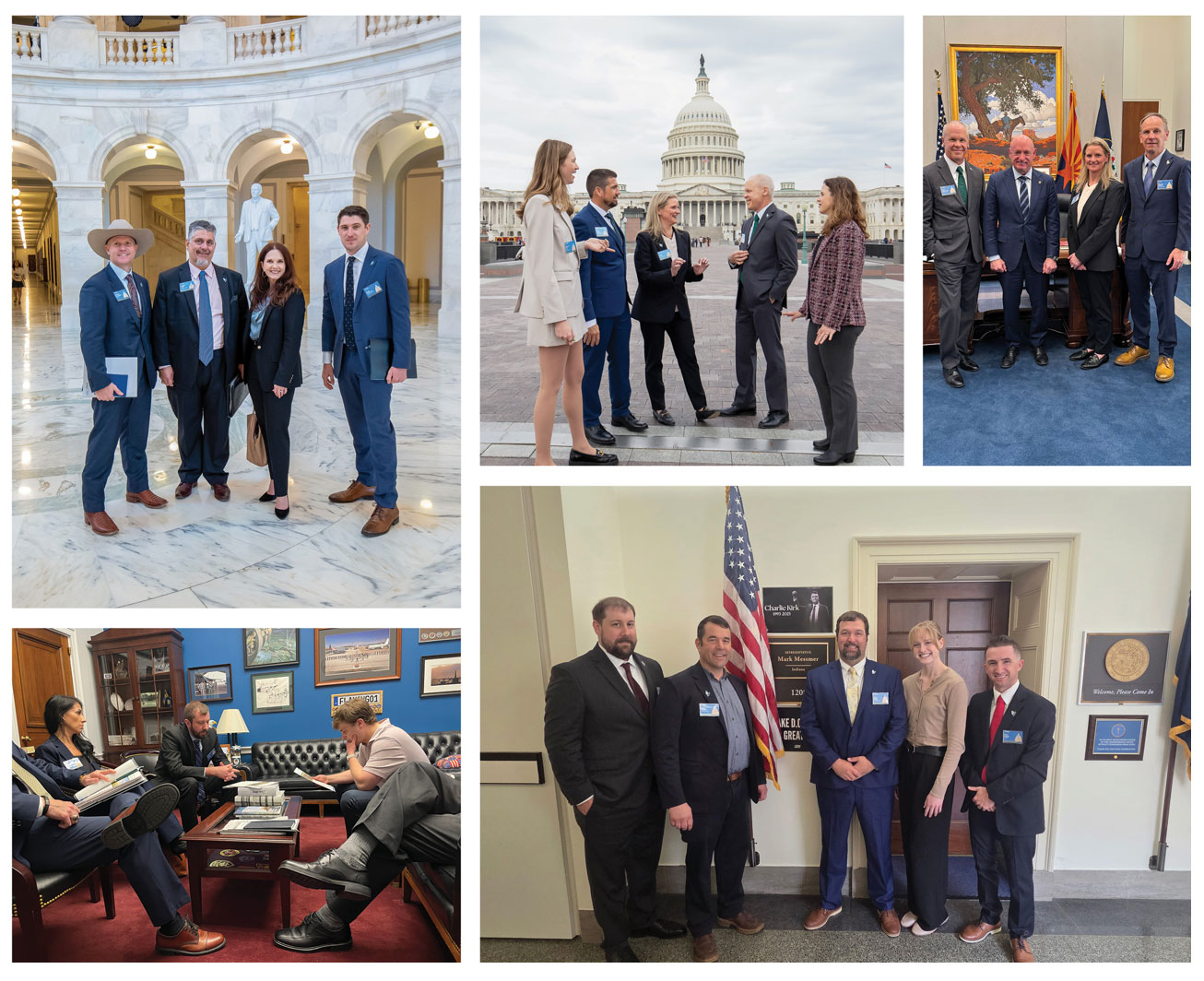
During the summit, IA members met with 27 congressional offices from across the country, representing a broad mix of committees and jurisdictions. These meetings gave participants opportunities to explain how federal policies translate into on-the-ground outcomes for contractors, manufacturers, farmers and communities.
“This is one of the few opportunities for Congress to hear directly from a national association focused specifically on irrigation,” says Morris. “Other organizations may touch on irrigation as part of a broader agenda, but the Advocacy Summit gives our members time to share deeper technical insight on the issues affecting our industry. That helps ensure irrigation expertise is part of the policy conversation.”
Following the event, one attendee reflects, “It’s easy to assume someone else is advocating for our industry and fully understands the nuance and technical skill behind the work we do every day. One of my biggest takeaways from the Advocacy Summit was realizing that my perspective adds value to the conversation. Participating in these discussions helps build connections and insights that will influence how I approach my work going forward.”
In addition to Capitol Hill visits, landscape participants joined a roundtable with EPA WaterSense staff, one of the IA’s key federal partners on landscape irrigation. The discussion focused on issues such as irrigation controllers, high-efficiency nozzles and WaterSense-labeled professional certification programs, while giving members the opportunity to share field-based perspectives on how water efficiency is achieved in practice.
“Agency staff are often limited in their ability to travel, so time in Washington is an important opportunity for direct conversation,” Morris says. “Discussions with EPA WaterSense help ensure that policies and programs reflect how irrigation systems actually perform in the field and how water savings are achieved in practice.”
Continuing the work
The annual Advocacy Summit remains a cornerstone of the IA’s advocacy work, reinforcing its role as a credible, solutions-oriented voice for the irrigation industry. Insights gained during the summit will continue to inform the association’s engagement with Congress and federal agencies throughout the year.
Looking ahead, the IA will continue building on these conversations as appropriations decisions take shape and federal water-efficiency and reuse efforts evolve. For landscape professionals, that means continuing to make the case that well-designed, well-managed irrigation systems are an essential part of healthy, functional and water-efficient landscapes.
“The conversations we had during the Advocacy Summit don’t end when the event concludes,” Morris says. “They help shape ongoing engagement and reinforce the IA’s role as a trusted resource for policymakers navigating complex water and irrigation issues.”