Lighting with purpose
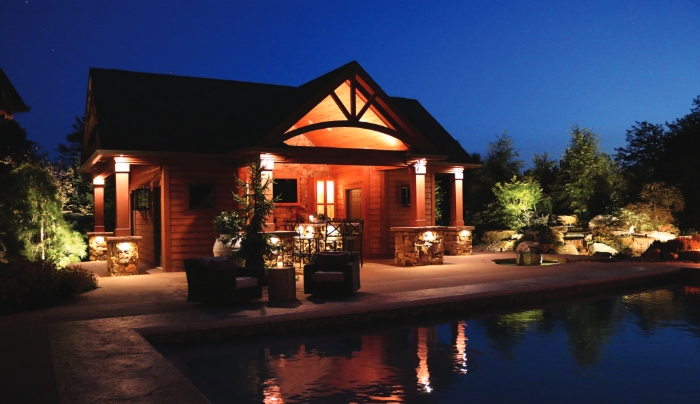
Outdoor lighting adds beauty and visual interest to residential, commercial and municipal spaces. It also has the added benefit of enhancing the safety and security of a property. While clients may approach a project with a specific goal in mind, experts say that with the proper planning and implementation, outdoor lighting can effectively satisfy each of those purposes simultaneously.
“Aesthetics, security and safety are the three components of outdoor lighting,” says Mark Heinzman, president of Heinzman Lights at Night, based in Indianapolis. “Most of the jobs I am designing are designed with a focus on aesthetics, but it’s easy to combine all three components. You can light up a tree or the front of the house for aesthetics, and by spreading light over your property, you’re increasing the safety and security.”
 It starts with a conversation
While conversations with clients often stem from an interest in enhancing architecture, drawing attention to hardscapes, or featuring ornamental plants or trees, the addition of light also enhances property safety and security.
“There are plenty of studies that show that a home with illumination is going to be less likely to be approached than a home that is dark,” says Todd Goers, CLVLT, director of sales at WAC Landscape Lighting in Port Washington, New York. “If someone is walking up to a home with a nice landscape lighting system, they feel exposed; they are in the light.”
Talking to clients about how they use their space and what look they’re hoping to achieve is the first step in identifying potential safety concerns or problematic areas. “When I go to a property, I’m taking in multiple points of view to get an overall feel for function and aesthetics of the lighting,” says Larry Baca, owner of Image Outdoor Living in San Diego. “I’m getting the lay of the land as the owner describes wants and needs. They’ll typically point out that ‘This back corner is really dark,’ or ‘These gates are frequently used,’ and I’ll take that into consideration.”
Enhancing safety
Understanding how a property or space is used is the first step to adding lighting that enhances both safety and security. Stairs are often areas of concern.
“Stairs can be very dangerous if they are not illuminated,” Goers says. “It is a trip hazard if you are trying to navigate up or down a dark staircase.”
Several manufacturers offer step lights, which are most often recessed into the face of the step. Step lights can be staged to add visual appeal while ensuring that the staircase becomes a functional space in the evening, Goers says.
 While lighting installation is easier in the construction phase, Goers says that contractors may come onto a project after a staircase is built. “There are flush-mounted products that can be installed on the face of the board, and that is what people turn to when they can’t get behind the steps to mount a junction box,” he adds.
Pathways and sidewalks are another area of concern for many property owners, and aesthetics should play a role when adding lighting to enhance safety and security. Heinzman says he avoids creating “the runway look.”
“When you’re doing sidewalks or pathways, if you have lights every 15 feet that light up a 7-foot area, you only have a 1- or 2-foot dark area before you hit another zone of light,” Heinzman says. “It’s OK to have a dark area, and in fact, you’re getting a better effect. You want it to be more underbearing than overbearing.”
While light is essential to creating safer spaces that are accessible and easy to navigate, Goers cautions that more light is not always better. “Less is often more in this landscape lighting field,” he says. “Even with step lighting, you may not need a light on every step; you may be able to go every other step.”
While more light might be overkill, it also can be distracting to people navigating through a space. “Your eyes will go to the brightest light, so you want your lights to work in unison with the rest of the landscape lighting so one doesn’t overpower the other,” Heinzman says. “You want balance throughout your yard. You don’t want to overweigh one area and minimize the other. If you do a panoramic view of the property, there should be balance throughout the whole property.”
“You don’t want to overweigh one area and minimize the other. If you do a panoramic view of the property, there should be balance throughout the whole property.”
— Mark Heinzman, president, Heinzman Lights at Night
Expert tips
Lighting contractors who design and install lighting day in and day out have amassed some tips for effectively enhancing safety and security while keeping an eye on aesthetics and functionality.
“There are a good deal of contractors who don’t like pathway lights, fixtures that are 22 inches, 23 inches, 24 inches tall,” Goers says. “They are often leaning, especially if there are big dogs or kids. They don’t look good when they’re leaning, and you have to constantly straighten them.”
Instead, Goers says he prefers to install downlighting on trees near the path. “The contractors that are the best at it, you won’t ever see the light source — you’ll just see the effect of the light, and that’s what you’re striving for,” he says.
While Baca recognizes the safety function of pathway lighting, he says that he also tries to avoid actual path lights whenever possible. “Maybe it is a walkway where we can add in-ground lights to uplight a wall, or maybe I try to put lights on an eave to downlight an area,” he says. “I always try to avoid traditional path lights if possible, so they are not getting kicked or knocked over. There are different ways to achieve lighting an area. Whether it is on an eave or a tree to downlight or shooting light across a path with in-ground indicator lights, the aesthetics will change with different techniques, but it will all help to alleviate safety concerns.”
Hiding the source of the light is one way to help ensure that the light or its glare isn’t blinding upon approach. Honeycomb louvers are another option for cutting a blinding glare. “You don’t want to walk up to a property and have a glare bomb hitting you in the face,” Goers says.
 Making adjustments
Once lighting is installed, taking a final walk around the property is essential to ensuring that the lighting satisfies all the requirements.
“I always go back at night and adjust lights,” Baca says. “I walk the property to get a feel for the actual function and flow of the lighting. That is the one biggest thing to installing lighting properly. You can get 90% there in the daytime, but unless you go there at night and actually see how it looks, you really don’t know 100%. I make sure I can see all the steps, see if there is any glare or hot spots from fixtures, if I need a frosted or honeycomb lens. It seems simple enough, but this step is often overlooked.”
It’s also important to make sure that any lighting enhances security from inside the home as well. That means considering the placement of light sources to allow a view of the property from inside.
“Fixtures shining up in front of windows is a terrible idea,” Goers says. “When you’re inside the house and you can’t see outside, someone could be looking in and you wouldn’t be able to see outside. It’s worse to put a light in front of a window than to have no light at all.”