For the professional irrigation contractor, reactive repairs are high-stress emergencies for their residential and commercial clients. Transitioning to a proactive maintenance program shifts the irrigation professional’s role from “break-fix” technician to steward of a critical asset.
Regardless of geography or climate, irrigation pros agree that consistent preventive maintenance, along with strategic seasonal setups, are universal requirements for long-term system performance.
More than meets the eye
Drawing from an extensive career in commercial irrigation, Eric Santos, CIT, CLIA, CGIA, CLWM, CAIS, CIC, CID, vice president of professional services at HydroPoint Data Systems in Petaluma, California, believes preventive maintenance inspections (PMIs) are a critical component of a comprehensive assessment. While the process is often more diagnostic than preventive, Santos says close inspections of wire connections and valve splices for operational integrity are equally as important as identifying existing failures.
Additionally, the advent of smart controllers with flow-sensing technology and digital dashboards may give contractors — and even clients — a false sense of security. Santos warns that relying on software can lead to the dangerous assumption that a system is at peak performance, but digital reports are no substitute for an observant walk through the client’s property.
“A dashboard is going to tell me where I have high-flow and where I have no-flow conditions,” Santos says. “But I still tell clients that the flow sensor is not going to tell you if a head is out of adjustment and is spraying out into the street. So, it’s still a good practice to get out and do those frequent in-person inspections.”
High-performing irrigation firms achieve greater financial rewards by prioritizing customer value. According to Scott Knowles, CGIA, CIC, CID, CLIA, a retired industry veteran based in Dayton, Ohio, who now focuses on educating the next generation of technicians through the Irrigation Association, elite preventive maintenance transcends mere reactionary repairs.
While average technicians focus solely on the immediate leak or broken sprinkler that prompted the service call, Knowles says superior irrigation professionals adopt a holistic diagnostic approach. They leverage their on-site presence to conduct comprehensive evaluations and offer proactive suggestions to commercial property managers, homeowners and athletic facility directors alike.
“Good irrigation techs aren’t just there to fix a leak,” Knowles says. “The good ones take a look around and make suggestions to the owners or site manager that there are [other system issues] to take a look at.”
This includes upgrading irrigation tech with mobile notifications, a move that enhances not only system performance but client peace of mind. Knowles adds that the most profitable irrigation companies move beyond the “fix-it” mindset, instead working with clients to leverage contemporary tools, technology and specialized knowledge to fine-tune an irrigation system for peak efficiency.
“The hallmark of a top-tier service technician is an observant eye and a focus on future-proofing,” Knowles says. “Rather than completing a task and departing, a technician should investigate potential vulnerabilities and upgrades the irrigation system might require in the coming months.”
By presenting findings directly to clients, irrigation techs transform a routine visit into a strategic consultation. According to Knowles, this approach creates a dual opportunity to enhance system reliability while driving revenue. “I’ve heard from contractors that 50% of the time they present an issue to the customer — ideally with a quote — the customer says, ‘Let’s just get it done,’ ” he says.
“The hallmark of a top-tier service technician is an observant eye and a focus on future-proofing.”
— Scott Knowles, CGIA, CIC, CID, CLIA, retired industry veteran and IA University instructor
INSPECTION FREQUENCY
The timing and frequency of irrigation system inspections often depend on regional climate patterns. Spring startup is temperature-dependent, not just calendar-dependent. The transition out of winter dormancy or the rainy season is unpredictable from year to year, further complicating PMI scheduling for irrigation contractors, says Eric Santos, vice president of professional services at HydroPoint Data Systems in Petaluma, California.
While monthly inspections provide the most comprehensive system oversight and contribute to improved water management, Santos acknowledges the industrywide debate over their cost-effectiveness.
“I’ve heard contractors say that if you’re doing [inspections] once a month, you’re spending a lot of resources to do those inspections, and you’re probably not coming back with a bunch of things that are broken,” he says. “That can mean less revenue.”
If this is the case, Santos urges contractors to consider a tri-annual approach — in the spring and again in midsummer, when irrigation systems have had time to thoroughly run and landscapes have peaked. This is often sufficient to maintain system health until the autumn shutdown and winterization. It also allows contractors to adjust controllers if midsummer heat and precipitation are oppressive.
“It’s important to get out [in early spring] and do those inspections and get those proposals in front of clients and approved, so when March hits, you’re off and running,” Santos says. “Once you get into September and October, you can suggest to clients the critical maintenance issues and areas for upgrades for them to consider before the next season.”
Eye spy
The cornerstone of professional irrigation service is the pursuit of peak system efficiency. Ryan Markway, CIT, CIC, Kansas City metro irrigation department manager at Ryan Lawn & Tree in Merriam, Kansas, frequently advocates for modern system upgrades, such as pressure-regulated heads and Wi-Fi-enabled controllers, but he maintains that high-level efficiency is achievable even with legacy systems. Nonetheless, they need to be maintained.
“I tell my guys, and I say it to clients all of the time, irrigation parts are plastic moving parts that are sitting outside, exposed to the elements, 365 days a year,” says Markway. “After 20 years, the gears inside the rotor have spun around thousands of times. They start getting smaller over time, and then they start missing and slipping. And if the rotors begin turning slower or not turning at all, the system is going to have problems.”
So, what are the hallmarks of an effective irrigation maintenance inspection that protects the client’s investment and prevents water waste? Irrigation pros suggest breaking down routine preventive maintenance visits into dry checks (static evaluations) and wet checks (dynamic evaluations).
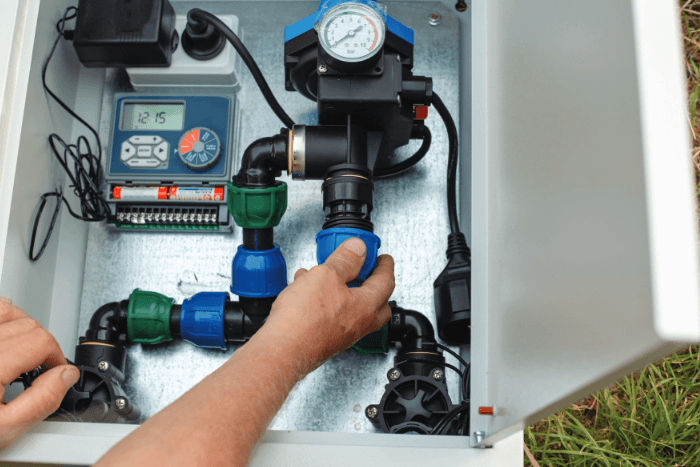
Before popping off the first valve, irrigation pros suggest inspecting the system’s brains and nerve center. This includes evaluating controller diagnostics, ensuring program run times are seasonally appropriate, checking battery strength and function, clearing debris from rain/ET sensors and visually checking the backflow assembly for external cracks and discharge from the relief valve.
 During this process, it’s also important to assess valve boxes. In addition to clearing debris, pros advise checking for signs of standing water — which may indicate a valve or manifold leak — evaluating the condition of brass components and stainless-steel handles, and inspecting wire connections for wear or critter damage.
“[The valve box] is a good natural environment for critters,” Markway says. “It’s warm, and it’s cozy. And if a mouse gets in, the first place he’s going to chew is that solenoid wire right at the top of the solenoid.”
Pros also encourage noting landscape obstacles. For example, a 20-year-old oak tree might now block a spray pattern that worked fine in 2006.
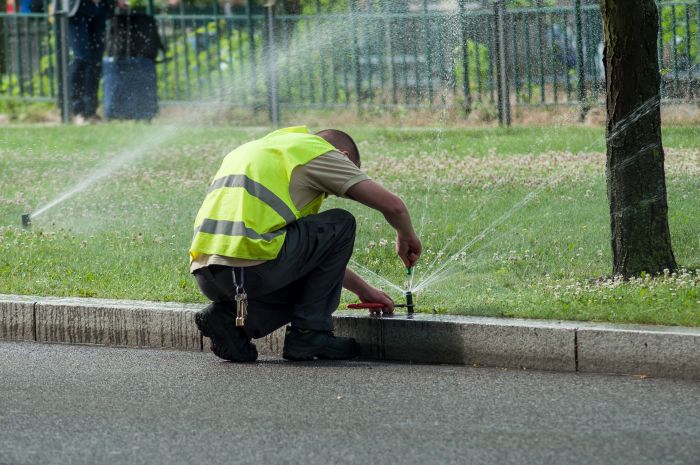
Once the dry check is completed, irrigation pros advise focusing their wet check on each zone in the system. This involves a meticulous evaluation of each individual sprinkler head to identify leaks, ensure correct head-to-head coverage, and verify that nozzles flow freely and are not clogged.
“I instruct young technicians to verify that every component is performing its intended mechanical function,” Markway says. “Rotating heads must move fluidly, while fixed heads must remain stable. And make sure they’re aimed right. Over time, heads get out of alignment and start spraying a little more toward the street or toward the house. That’s an indicator that the head could have some wear and tear.”
Moving beyond sprinkler heads, valve operational efficiency is critical. Markway recommends that contractors monitor zone activation and deactivation speeds. While lateral lines take time to pressurize, Markway notes that zones closing slowly in the average residential or light commercial system typically indicates a valve issue.
“At that point, you may not have to do anything, but it’s worth a conversation with the client that you’ve noticed these valves are starting to shut slowly,” Markway says. “It’s something to keep an eye on and [they should] notify you if there are any issues.”
Santos says maintenance inspections must prioritize system efficiency by identifying the key factors that impact water distribution. By ensuring matched precipitation rates and verifying head-to-head coverage, he says this process moves beyond a simple check to improve system integrity, even if it doesn’t match the technical depth of a formal audit.
“A wet check is pretty telling,” Santos says. “A lot of times you can tell if an irrigation system has excessive pressure just by looking at the misting, without going through the effort of putting a pressure gauge on the sprinkler head.”
Irrigation pros also warn of the diagnostic complications when troubleshooting “Frankenstein” systems — those that have been cobbled together over time from mismatched parts, inconsistent brands and amateur repairs. To navigate these complexities, Markway suggests using a multimeter to gather specific ohm readings to analyze the electrical signatures of healthy solenoids, allowing technicians to differentiate between a functioning circuit and one on the verge of failure.
“Someone may have installed Rain Bird valves and then thrown in some Toro valves a few years down the road,” he says. “If there’s been additions or remodels of some kind, then [a multimeter reading] will give you some indication without having to pop open every valve box in the system.”
“Without precise records, clients mistakenly believe a previous repair has failed or that they’re being overcharged for redundant work. That’s when things start to spiral.”
— Eric Santos, CIT, CLIA, CGIA, CLWM, CAIS, CIC, CID, vice president of professional services, HydroPoint Data Systems
Building client trust
Irrigation pros advise documenting every deficiency discovered during PMIs, expecting that the company will eventually have to justify the necessary repairs to the client. For example, if a nozzle requires replacement, the documentation must specify whether it is clogged, cracked or simply the incorrect model for that specific zone.
This means moving beyond vague paper notes stating “broken head on zone five.” Santos recommends leveraging third-party software to provide clients with a transparent, data-driven record of irrigation system health. By documenting the exact where and why of every repair, Santos says irrigation contractors can mitigate the breakdown of trust that often occurs when clients question the necessity of ongoing maintenance.
“This shift is critical for maintaining client trust, particularly when a property requires frequent repairs on the same zone or station,” Santos says. “Without precise records, clients mistakenly believe a previous repair has failed or that they’re being overcharged for redundant work. That’s when things start to spiral. Anything you can do through the use of pictures and documentation is really going to help build that level of trust [with clients].”
Furthermore, irrigation pros maintain that this detailed approach accelerates the approval process for repair proposals. With proof in hand, clients better understand how even minor mechanical issues compromise irrigation system uniformity, leading to costly water waste or damage to the surrounding landscape.
CALLBACK FATIGUE
The plague of callback fatigue in irrigation maintenance is a byproduct of deficient technician attitude and a lack of specialized knowledge, according to retired industry veteran and IA University educator Scott Knowles, CGIA, CIC, CID, CLIA. Left unchecked, it can eat away at margins and sink otherwise profitable companies.
When an irrigation technician is trained in hydraulic theory rather than just head-swapping, repairs hold up. However, a technician who lacks competence or approaches the task with indifference inevitably produces subpar results that fail shortly after completion, Knowles says.
This failure triggers a frustrating cycle for the homeowner or property manager, who may be alerted to a recurring leak by either a smart controller or visible failure of the system itself. These persistent mishaps, Knowles says, are not only expensive to the contractor — the service call isn’t billable — but they destroy trust, which is invaluable and difficult to rebuild.
“Building trust is very simple,” he says. “You do what you say. You tell [clients] what is real, you bill them fairly, and you respond and handle issues.”