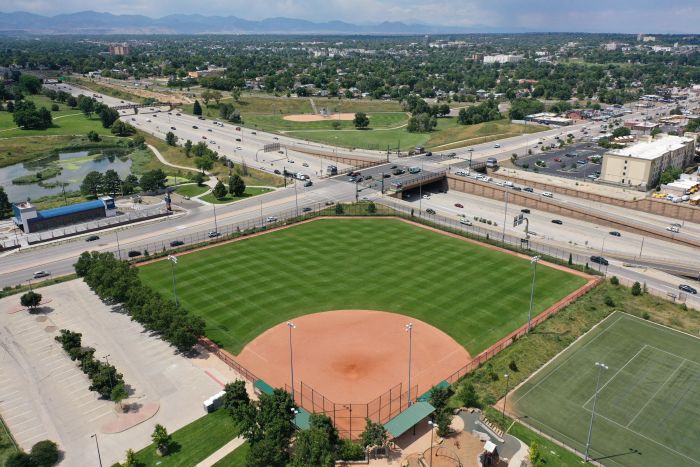
Denver Parks and Recreation (DPR), like many municipalities nationwide, is faced with reducing water use. For Denver, it is a 20% reduction for the 2026 season based on Denver Water’s Water Budget Program. The mandate reflects a broader shift as municipalities rethink how irrigation is managed in parks and public spaces under increasing water constraints.
To meet that target, DPR is building on more than a decade of investment in centralized irrigation control and water-efficient design.
“Over the past decade, DPR has systematically converted all park irrigation controllers to a central control system,” said Stephanie Figueroa, marketing and communications specialists for the City and County of Denver Parks and Recreation department. “Today, our network includes 740 controllers serving more than 330 parks.”
Figueroa said the centralized system has reduced water consumption by an average of 20% and saved millions of gallons during major rain events.
“Our system incorporates a network of weather stations and rain sensors that provide real-time monitoring, enabling automatic rain shutoffs and evapotranspiration (ET)-based irrigation scheduling,” she said.
Like Denver, municipalities across Arizona, including those who are members of the Arizona Municipal Water Users Association, have been investing in upgrading to smart controllers. Caitlyn A. Hall, PhD, water conservation and demand management for AMWUA, highlighted Phoenix Parks and Recreation as one example. The department has invested $2 million since 2012 installing smart controllers across 90% of its largest outdoor facilities. The Scottsdale Parks department has documented more than 3 billion gallons in savings over roughly 25 years, routinely using 15% less water than its annual allotment. A combination of smart controller installation, turf conversion and water budget programs contribute to the overall reduction.
While central smart controllers play an important role in improving water use efficiency, combining multiple strategies makes the most significant impact. About 30% of Denver’s parks are irrigated with recycled water, part of a long-standing partnership with Denver Water. The city has used recycled water for more than 15 years, though Figueroa noted it can present challenges for mature conifer trees, a factor municipalities should consider in long-term planning.
“If this option [using recycled water] is available, we strongly recommend implementing it as soon as possible,” Figueroa said. “It is a critical strategy for improving the sustainability of urban parks and enhancing water security in arid and semi-arid climates.”
DPR has also been replacing traditional bluegrass turf with drought-tolerant native grasses and, in 2026, will shut off decorative fountains to prioritize water use for higher-value assets such as athletic fields and tree canopies.
Combining technology with data
Many municipalities are pairing efficient design, water-saving system components, smart and central control systems with audits and data to meet water conservation goals. Reports and audits are helping maintenance teams with fine-tuning scheduling, detect problems early and make more informed water management decisions.
“Several AMWUA members have also paired smart controllers with monitoring platforms to generate water use reports and consumption alerts,” Hall said.
For example, Hall noted that in Gilbert, all parks and town facilities are enrolled in the Waterfluence Water Wise program that provides real-time consumption data and reports. Third-party irrigation audits are also playing a key role in improving system efficiency. In November 2025, Chandler launched its LEAP program in partnership with SRP.
“[Chandler’s program] uses an independent consultant to audit irrigation systems across 75 municipal parks and city facilities over five years, with SRP providing matching funding of up to $10,000 per improvement project,” she explained. “Gilbert completes water audits at all its parks and facilities throughout the year, and Scottsdale Parks maintains a water budget for each park and annually analyzes grass areas for conversion opportunities.”
One of the biggest factors to the success experienced by municipalities ties into proactive planning. Hall noted that members have documented how planning and funding programs before critical shortage conditions delivers better results than those assembled under pressure.
“The AMWUA region has made significant conservation investments over decades, but as Colorado River uncertainty grows, even cities with strong track records are finding that more is needed,” said Hall. “Securing funding, building contractor capacity and establishing programs before they are urgently needed reduces “speed bumps” and produces better outcomes.”
Bottom line
The cities and practices highlighted here are just a few of many examples of how municipalities are leveraging sustainable irrigation and water-use practices. Water savings strategies also extend beyond those highlighted here. But the bottom line is that municipalities that invest early in irrigation upgrades and planning are better positioned to respond as water constraints intensify.
Photo courtesy of Denver Parks and Recreation.