What happens when outdoor lighting — intended to add depth and interest to a property, to enhance accessibility along pathways and steps, and to enhance the overall feel of a space — isn’t thoughtfully planned and installed? As outdoor lighting systems become more sophisticated and control options for property owners expand, many lighting designers and experts are focusing on designing and installing lighting systems that reduce light pollution and its unwanted effects.
The effects of light pollution
According to Dawn Hollingsworth, CLD, FIALD, WELL AP, principal of Darkhouse Lightworks in Los Angeles and treasurer of the International Landscape Lighting Institute, there is much research on how outdoor lighting affects plants and animals who depend on darkness for survival.
“The abundance of light at night is a problem for insects and animals who depend on darkness as cues for certain behaviors,” Hollingsworth says. “If there is too much light, insects don’t know if they are to pollinate or to mate, behaviors that depend on darkness in the environment. For predators who hunt better using night vision, too much light is confusing, and they can’t hunt because prey see them coming.”
While many industry professionals understand the negative impact of pesticides on pollinators, Hollingsworth says many are unaware that light can be equally damaging.
“Light has had as big an impact on the decimation of insect species that pollinate food as pesticides,” she says. “We need pollinators to pollinate plants and trees, and by impacting the life cycle of insects, it is impacting our food sources.”
Residents of most major metropolitan cities are well aware of another negative effect of light pollution: an inability to truly enjoy the night sky.
“People in most cities can see very few stars, as the city can’t even get to full darkness,” Hollingsworth says. “A focus on light pollution can mean the ability to restore darkness in the night sky.”
The good news: with an understanding of where light pollution originates and how to properly design and install lighting to mitigate its effects, lighting professionals can continue to deliver the aesthetically compelling, functional projects that clients desire while protecting the environment.
Principles of responsible outdoor lighting
DarkSky International, an organization that advocates for responsible outdoor lighting, has prescribed five main principles that can guide the process of equipment selection and lighting solutions, says Wes Jackson, vice president of Jackson Lighting in Austin, Texas, and board member of ILLI. He says the guidelines aren’t difficult to adhere to if lighting professionals begin with a clear intent for the light, adding that any contractor can easily evaluate how a lighting design meets these guidelines.
The first principle is that light should be useful.
“There needs to be an actual intent to it, but that’s a debate that’s subjective,” Jackson says. “What is the client’s use and perspective of the space, and how does it impact safety concerns or quality of life?”
Some clients are most comfortable with an illuminated boundary, while others favor highlighting a vignette in which they will be active, Jackson says. In other words, all outdoor lighting should be designed purposefully.
The second principle of responsible lighting is that it should be targeted.
“Light should be fully shielded, and there should be no light-source trespass to adjacent properties,” Jackson says.
While not all products on the market have glare-control options, many do, and Jackson encourages lighting professionals to create designs that use these options to prevent glare or source visibility. He says this includes selecting products that have glare-control features such as honeycomb louvres and extended shrouds. While these features are more standard with architectural and specification-grade products, there are glare-reducing accessories that are compatible with most light sources.
The third principle of responsible lighting is using low levels of light.
“You don’t need a whole lot of light to give reflection off an object in a dark environment,” Jackson says. “Have intent with the level of intensity of light sources, and use the lowest output you can when setting a reference point in a lighting composition.”

Jackson says that a 2-foot shrub serving as a perimeter accent requires a different output than a 10-foot tree that is a focal point, so tailoring the output to the object and situation is a key factor in mitigating excess light.
The fourth principle is that light should be controlled, another one that Jackson says is subjective.
“When should lights be on, when do the lights need to go off or be conditioned?” he says. “If you’re not there and the space is not visible or occupied, lights don’t need to be on.”
Options for controlling light include motion sensors, occupancy sensors, ambient-light sensors, dimmers, and any other control that toggles or manipulates the lighting system. Jackson says not factoring controls into lighting design would be “a major issue.”
The last principle of responsible lighting is choosing warm light.
“DarkSky International has recommended a Kelvin temperature maximum of 3,000 kelvins or less,” Jackson says. “Keeping the blue wavelength out of the light sources allows wildlife, plants, insects and humans to have a more regulated sleep cycle.”
“Have intention with the level of intensity of light sources, and use the lowest output you can when setting a reference point in a lighting composition.”
— Wes Jackson, vice president, Jackson Lighting
Using expert guidance
In addition to offering principles for responsible outdoor lighting, DarkSky International has also collaborated with the Illuminating Engineering Society to develop a system to measure light outputs. The BUG rating system provides a certification for how much backlight, uplight and glare each fixture carries, says Thomas Paterson, director of lighting consultancy Lux Populi, headquartered in Mexico City.
“Increasingly, fixtures carry a BUG rating, but not universally,” Paterson says. “There are free softwares that can take the lighting performance and tell you the BUG rating, and many sales reps will do a calculation.”
Paterson says an understanding of lighting zones is also useful information that can help guide lighting professionals in designing and choosing lighting for different areas of the world. According to Paterson, every location is rated from LZ0, which includes undeveloped areas in national or state parks, to LZ4, which includes heavy industrial areas or high-density entertainment areas like Times Square in New York.
While Paterson says there are some pockets of states and cities around the United States that are very sensitive to the issue of light pollution — including Utah, Wyoming, Colorado, New Mexico, and Malibu, California — he notes that in many other places, industry professionals are only in the early stages of awareness.
Lighting for security
While having some light can be a crime deterrent, Paterson says lighting for security purposes does not require flooding entire properties with bright light. While some studies show that more light equals a more secure property, Paterson says that homes that appear cared for and occupied do not require dusk-to-dawn lighting for safety.
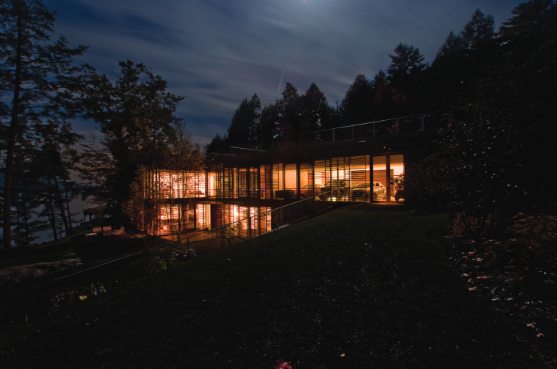
“The light doesn’t have to be much, and it doesn’t have to be outside,” Paterson says. “If it’s going to bring you welcome, a moderate amount of light when you come home is nice. Good lighting design practice would have light only when you’re using it for its purpose.”
Paterson says table lamps (with high-efficiency bulbs) strategically placed inside the home give the impression that someone is there when on. Security lighting with motion sensors is another good option, as long as the sensors are programmed correctly.
“Make sure they don’t nuisance trigger by someone walking down the street,” he says. “Make sure the coverage is only where you want to detect people. I’m not a big fan of it, but if you feel you need it, that’s the right way to do security lighting outside.”
Another option for enhancing security while limiting light pollution is using infrared light.
“If you have any type of outdoor camera, the best lighting for that is an infrared light,” Paterson says. “It is the least harmful, interrupts the least species, and you can have the whole space floodlit for the camera, but it is invisible to most humans and animals.”
A learning curve for everyone
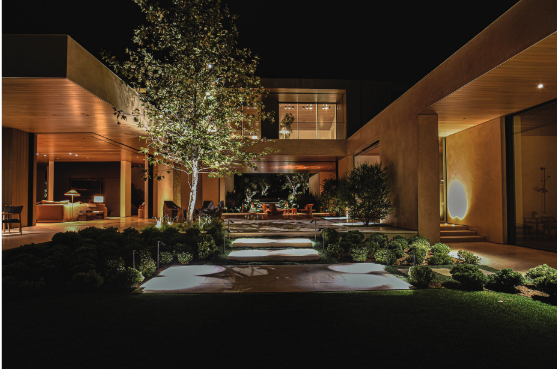
Hollingsworth says she believes lighting professionals and the industry as a whole have a responsibility to determine which lighting solution is right for each environment and to adhere to industry best practices for lighting in a responsible way. She also says that it is incumbent on industry professionals to educate clients on responsible lighting practices.
“There are a lot of people who don’t understand that light pollution … is a real problem,” Hollingsworth says.
Jackson says lighting professionals also have a responsibility to educate clients on how their lighting goals can best be achieved.
“The human eye will adapt to the brightest object, so your eyes will orient themselves based on the brightness level,” he says. “If you’re in a darker space with a lower light level and shielded light sources, you see more than you would in a higher-ambient-light environment with unshielded light sources. The best practice in landscape lighting design is to see the effect, not the source, so you want to hide all light sources.”
While many municipalities are attempting to add or adjust ordinances to limit light pollution, Paterson says he encourages all industry professionals to focus on the overall purpose of outdoor lighting.
“Lean into the pleasure of dark, gently lit spaces,” Paterson says. “It’s one of the greatest pleasures to step out and not be in architecture. We spend our life in hard spaces. The night should be a pleasure and should feel like the night. You can augment it and decorate a little, but enjoy the night.”