As the president of Beacon Outdoor Lighting in Naples, Florida, Cory Moore designs and installs outdoor lighting. The driving factor in his work is truly understanding customer wants and needs.
“Everybody uses their spaces differently, and as a lighting designer, our job is to understand how the customer is going to use the space and then design around that,” Moore says. “We are the customers’ psychologist, and it is our job to uncover who they are and how they’re going to use the space.”
According to Moore, designing lighting to suit a customer’s lifestyle relies on an understanding of how a customer interacts with their space. Do they have a family? Do guests or aging family members frequently use or visit the space? How will the space primarily be used? What areas of the home are most often used?
“We will walk around their house and sit in the specific areas,” Moore says. “When you do that, you’re designing for the human experience for that customer. If you understand the customer and how they’re going to use the space, then design a lighting system that accommodates the way they live, you’ll have happy customers.”
The right light is customer-specific
While there are some rules of thumb for outdoor lighting that enhances security, improves way-finding and balances aesthetics and practicality, Brian Stephens, training and development manager for Southern Light Inc. in Nashville, Tennessee, agrees that providing a lighting design that fits with and enhances a customer’s lifestyle is the ultimate goal.
“When we meet with a customer, we ask them what their needs are to determine if they want their landscaping accented, if they want to show off their home, if they have gas lanterns that should be considered, dormers, second levels or bay windows that they’d like to accent,” Stephens says. “It really depends on the customer and what their needs are.”
Moore says that once he understands how a customer will use a specific space, his next goal is to create a scene that encourages people to use spaces in specific ways. While a flood of bright light certainly illuminates a space, the lack of varying light levels does little to enhance the interest of that space.
“High levels of light and low levels of light create an impact,” Moore says. “As a designer, I try to create as many varying light levels as possible. I never want one blanket level of light through a property, because that feels very commercial. I create interest and drama with light going from high levels to low levels of illumination, and that brings depth and interest to the property.”
Leading with light
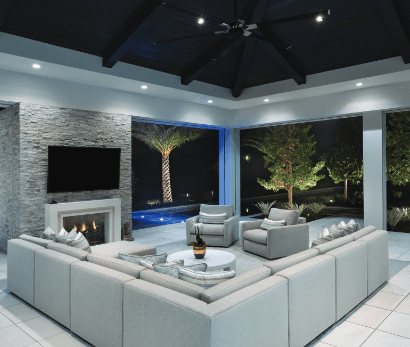 While light adds drama and interest, it also serves the very practical purpose of helping people move from one area to another. Moore says that path lighting is an easy way to encourage foot traffic.
“Our design team tries to create walkways and areas of foot traffic, and there are a couple ways to do that, like having increasing levels of light in areas you want people to navigate to and decreasing levels of light in spaces you want to keep innocuous,” Moore says. “We use different brightness levels to encourage and discourage where people go.”
One big design rule that Moore and his team try to follow is to increase light output approaching entry and exit points.
“When you pull up, you should get that wow effect, and from there, the lights should start to increase in output as you come to the front door,” Moore says. “If an area isn’t adequately illuminated, your eyes have a harder time going from high levels of light to low levels of light. You want your eyes to slowly adjust between the two.”
Because aging eyes adjust to changing levels of light more slowly, the layout for path lighting is especially important. Understanding the radius of a specific fixture is important to the design process.
“The biggest cardinal sin is a handful of path lights leading to a front entry,” Moore says. “Oftentimes, no path lighting is better than a horrible path light layout.”
Moore says the light radius should slightly overlap so there are no pockets of darkness. In addition to providing a cleaner look and feel, it ensures a balanced level of light along the way.
“You want to create contrast in the aesthetic, but when it comes to path lighting, it’s not about contrast; it’s about creating a harmonious layer of light where your eyes don’t have to adjust repeatedly,” Moore says. “You might as well not have light and let your eyes adjust once rather than trying to adjust between high and low levels of light.”
“There are lighting systems that change the atmosphere with color-changing temperatures, where the homeowner is basically their own lighting designer.”
— Brian Stephens, training and development manager, Southern Light Inc.
Lighting for mood
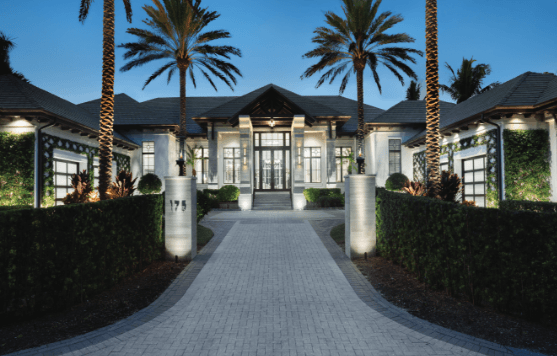
When it comes to choosing the right color temperature, Moore says that the specific Kelvin plays a big role in setting the mood of any space.
“We help navigate that process with our clients who bring their preferences to the table,” Moore says. “They may have a temperature in mind that they want to use that they are comfortable with, and from there we try to guide them to what’s ideal for the situation, location and even architectural style.”
Moore says that Kelvin temperature has a direct correlation to heart rate, and he says he focuses on building lighting that complements the way a space is designed to function.
“Three thousand Kelvin is what most people consider to be a nonoffensive Kelvin temperature,” Moore says. “It doesn’t feel too modern. It doesn’t feel too antiquated. It’s a very safe Kelvin. We will, if the scene calls for it, have different Kelvin temperatures in that scene. In a slowdown area, we will have a warmer Kelvin. In an area designed to accommodate guests, like a gazebo or covered pergola, you would want 3,000 or 4,000 Kelvin, which is a little more lively and keeps everyone awake and having fun.”
In addition to mood, temperature also influences the function of a space. With a higher Kelvin, Moore says there is slightly less distortion in color.
“At a warmer 2,200 or 2,700 Kelvin, if you’re trying to visually inspect if a steak is done, it’s hard to see the colors,” Moore says.
That’s exactly the reason that Stephens says he often includes switches in certain areas, so homeowners can determine when to use certain lights.
“If there is a lighting around an entertainment area and the owner wants to cook on a gas grill in the corner where it is dark, we install a light over the grill area with a switch, so the homeowner has the ability to turn it on and off,” Stephens says. “Maybe you don’t want to see the grill the whole time, but you want to have light for practical purposes only when you want it.”
Lifestyle lighting
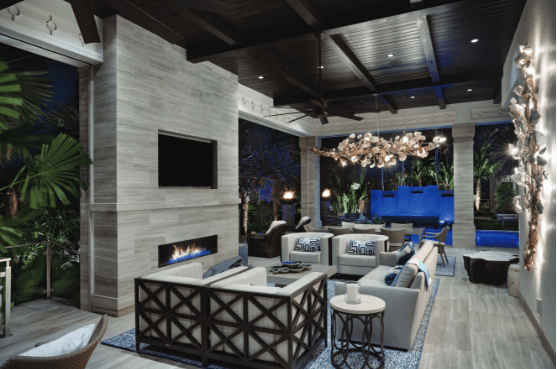
For clients who spend a lot of time in their outdoor space, Stephens says there are systems that put the homeowner in control, essentially allowing them to become their own lighting designer.
“There are lighting systems that change the atmosphere with color-changing temperatures, where the homeowner is basically their own lighting designer,” Stephens says. “They can change the hue and color, and the system is dimmable to where it can be toned down to 5%, just barely glowing.”
While he says he doesn’t recommend this type of system for the front of the house, the more than 3,000 colors, multiple themed lighting presets and complete flexibility to change lighting with the push of a button is appealing to some homeowners.
“It’s a pricey system, but it’s user friendly and can be cloud-based to turn the lights on and off,” Stephens says. “You can use your phone to change the ambiance, and you can easily change the theme of the lights.”
With any lighting system, Moore says, the most flexible option is having multiple lighting zones on their own transformers. He encourages clients to at least consider having a few different lighting zones.
“We push at least a front lighting zone, rear lighting zone, and a master view corridor or a privacy garden off the master, if there is one,” Moore says. “The more controls the better, but it all comes down to budget at the end of the day.”