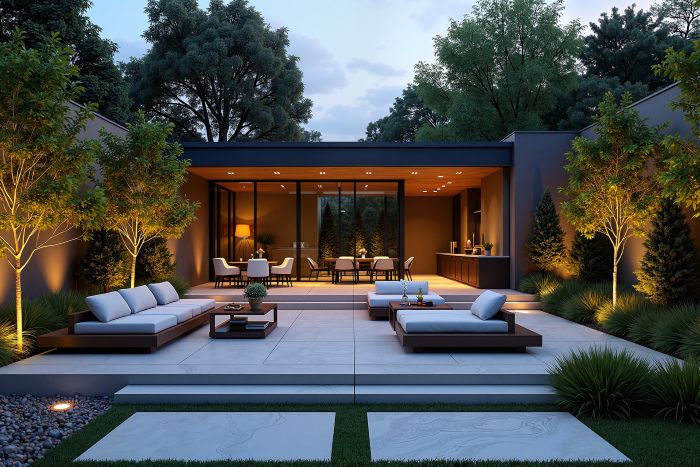
Designing a path lighting layout is one of the most important—and often underestimated—components of a well-executed landscape lighting system. While uplighting and architectural lighting tend to get the spotlight, path lighting plays a critical role in safety, usability and the overall nighttime experience of a home.
When done correctly, path lighting should feel effortless. It should guide movement, enhance the property’s aesthetic and blend seamlessly into the environment without drawing attention to itself. Achieving that balance requires intentional design, not just placing fixtures along a walkway.
Here’s a comprehensive look at how to properly design a path lighting layout for a residential space.
Start with purpose: Safety vs. aesthetic
Before placing a single fixture, it’s important to define the purpose of the path lighting.
Is the goal primarily safety? Is it to create ambiance? Or is it to enhance architectural and landscape features?
Most high-end residential projects require a combination of all three. Main walkways leading to the front door, driveway, or outdoor living areas typically prioritize safety and visibility. Secondary paths—garden trails, side yards or stepping stone walkways—lean more toward ambiance and subtle guidance.
Understanding the intent of each path allows you to adjust brightness, spacing, and fixture selection accordingly.
Understand how people actually move
One of the biggest mistakes in path lighting design is relying solely on hardscape drawings rather than real-world use.
People don’t always walk exactly where the path suggests. They cut corners, enter from different angles, and pause at transition points like steps, gates, or intersections.
A strong layout accounts for
- entry and exit points
- changes in elevation
- decision points (where paths split or turn)
- high-traffic vs. low-traffic areas.
Designing for actual behavior—not just the blueprint—results in a more intuitive and functional lighting system.
Spacing strategy: Avoid the runway effect
Even spacing on both sides of a walkway is one of the quickest ways to make a lighting system look overly rigid and unnatural. This “runway effect” is common in lower-end installations and immediately detracts from a high-end aesthetic.
Instead, aim for a more organic layout:
- Stagger fixtures from side to side
- Vary spacing slightly based on surroundings
- Use landscaping to help conceal and soften placement
Typical spacing ranges from 8 to 15 feet, depending on fixture output, mounting height, and surrounding ambient light. However, spacing should always be determined by light distribution—not just distance.
Foot candles: Designing for consistent Illumination
A key metric in professional lighting design is foot candles, which measure the amount of light reaching a surface.
For path lighting, we aim for a minimum of 0.1 foot candle across the walking surface. This level provides sufficient visibility for safe navigation while maintaining a soft, inviting ambiance.
Equally important is consistency.
Rather than creating bright spots under each fixture and dark gaps in between, the goal is to have the light radiuses overlap slightly. This creates a continuous wash of illumination, allowing the eye to move comfortably through the space without constantly adjusting between high and low light levels.
When light levels fluctuate too drastically the space feels disjointed, visibility can actually decrease due to eye strain and the overall experience feels less refined.
A properly designed system maintains a smooth, even distribution of light throughout the path.
Fixture placement: Subtle but strategic
Path lights should never feel like they’re lining the walkway. Instead, they should feel integrated into the landscape.
Best practices include the following:
- Place fixtures slightly off the path, not directly on the edge
- Tuck them into planting beds or ground cover when possible (never in the grass)
- Position them where they won’t interfere with foot traffic or maintenance.
It’s also critical to consider sightlines. Think about how the path looks from the street, the front door and outdoor living spaces such as a lanai or pool area.
Every fixture should contribute to the overall scene—not distract from it.
Light distribution and beam control
Not all path lights are created equal. The design of the fixture—particularly the hat and lens—plays a major role in how light is distributed.
A quality path lighting layout should eliminate harsh glare and provide a soft, downward spread of light, while also avoiding hot spots directly beneath the fixture.
Overlapping beam spreads is key. Each fixture should “hand off” light to the next, creating a seamless transition across the walkway.
Material and finish: Matching the home
Path lights are larger, more visible fixtures compared to many other elements in a lighting system. Because of this, the finish matters.
To create a cohesive look match the fixture finish to exterior sconces, trim and architectural details. If the home features black sconces and black trim, use black path lights, and if the home leans toward bronze or copper tones, reflect that in the fixtures.
This attention to detail ensures everything blends harmoniously rather than standing out unnecessarily.
In addition to aesthetics, material selection is critical—especially in coastal environments. High-quality brass or copper fixtures offer superior durability, corrosion resistance, and long-term performance.
Integrating with the landscape
A great path lighting design doesn’t just illuminate the walkway—it enhances the surrounding landscape.
Consider the following when planning a design:
- existing plant material and how it interacts with light
- future growth and how it may block or diffuse illumination
- opportunities to highlight textures like stone, mulch or ground cover
Lighting should feel layered. Path lights work best when they complement uplighting, downlighting, and accent lighting throughout the property.
Bringing it all together
A well-designed path lighting layout is about more than just visibility. It’s about creating a seamless, comfortable, and visually appealing experience that enhances how a property looks and feels after dark.
Focus on these elements to create a system that not only functions beautifully but elevates the entire property:
- consistent foot candle levels (minimum 0.1)
- overlapping light distribution
- thoughtful spacing and placement
- cohesive materials and finishes
- integration with the overall lighting design
Cory Moore is the president of Beacon Outdoor Lighting in Naples, Florida.