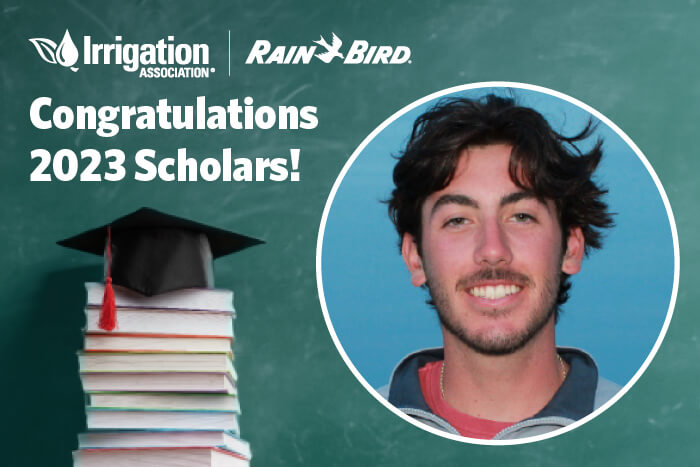
Learn more about some of the 18 recipients of the Irrigation Association’s 2023 Anthony W. “Tony” LaFetra Scholarship Program sponsored by Rain Bird, given to college students studying and pursuing careers in the irrigation field.
The scholarships, ranging from $1,000 to $3,000, were awarded to students who have shown a passion and interest in sustainability, stewardship and use of water, and the essential contributions irrigated landscapes and irrigated agriculture have in improving the quality of life through a reliable global food supply and vital green spaces.
Since the program’s start in 2016, 115 students have been awarded scholarships.
Matthew Antunes
Undergraduate student at the University of Connecticut, Storrs, Connecticut
Recognized as a 2022 Anthony W. “Tony” LaFetra scholar, a special designation awarded to the top two winners each year.
Tell me a little bit about your background.
I am from Smithfield, Rhode Island, and have resided here my entire life thus far. I come from a family of four with a younger brother who is going into high school next year. My father has worked in the irrigation industry for the last 10 years and my mom is a teaching assistant at an elementary school. I personally have been interested in the turf industry as a whole for seven years now, starting with volunteering my time to prepare little league fields for games. I love to golf and ski in the winter and pretty much spend the remainder of my time outside of school and work doing those two activities. I am very grateful to say that I have played Torrey Pines once before and still hold that at the top of my list of courses played.
What inspired you to pursue landscape irrigation as your course of study?
My father being in the industry and also my own curiosity of the industry (were inspirations). Knowing some people in the industry prior to me getting fully into it also helped to guide my inspiration in pursuing turfgrass as my course area of study. It also inspired me to build my own putting green at my house which I still manage today. It is hard to point to one area or person that sparked my interest in the industry but having my father talking about irrigation quite a bit got my attention.
Is there a course or part of your studies that has been particularly interesting and exciting?
Water management is probably the most interesting part of turfgrass science that I have learned thus far. Irrigation is a key part of water management as everyone knows but it is very interesting to see the paths cross in disease management, drought management and even pest management. Too much water and you increase the chances for disease and pests and too little results in drought.
Can you tell me a little bit about what smart irrigation means to you?
Smart irrigation, to me, means using weather data as well as on-the-ground soil moisture data to water effectively and efficiently. Combining ET rates with moisture readings could help managers effectively apply the correct amount of water needed instead of just watering for a set amount of time.
What advancements in irrigation technology are you particularly excited about?
(I’m excited about) moisture meters, on-site weather data to adjust run times, decoders in the sprinkler head case for ease of use, remotes on phones and much more. Technology has been such a great help with watering systems and the ease of use recently. New technologies allow for managers to water from their phones which allows them to multitask and get more done during the day. Personally, I think that is the greatest achievement so far in the industry. Newer ideas such as decoders in the sprinkler head make digging up irrigation heads much easier and most of the time you don’t need to unless there is something that completely needs to be replaced. Much of the head parts are exposed in the shell, so it makes repairs much easier to complete. I look forward to what new technologies companies come up with in the future!
What are your ultimate career goals in the irrigation industry?
My career goals as far as the irrigation industry goes is to become a superintendent in the future and understand irrigation like the back of my hand to make diagnosing issues easy. I want to understand and be able to apply all of the principles that make up an irrigation system to understand what salesmen are explaining to me. To do this, I hope to continue to soak in knowledge from the managers I work for currently and also their sales representatives that come every now and then. I hope to be a knowledgeable individual regarding irrigation in the future.
Here are some quotes from other scholarship winners for 2023:
Zachary Sannar – Utah State University – “This scholarship will help me to advance in my education and develop better irrigation design techniques in my future career as a landscape architect as well as advocate for the future of water-wise landscape and irrigation design throughout Utah and the Intermountain West.”
Cynthia Robbins – Saddleback College/Mira Costa College – “I want to create more native plant habitats within communities through landscape design. I want to empower people to understand their own landscape and how to make it beautiful and wildlife-friendly while also making it water-efficient.”
Hattie Witherell – Oklahoma State University – “I have discovered how valuable knowledge of irrigation is to landscape management and design. I did not know anything about irrigation when I first started my irrigation course and have learned so much about it since then. When I had an internship last summer (2022) at a butterfly garden, I was put in charge of managing and repairing the irrigation system there which I was able to successfully do, relying on what I had learned during my irrigation class.”
Mary Rodriguez – Miracosta College – “I realized how much I enjoy irrigation, and I decided to focus more on water conservation and irrigation design. I want to develop my career in the industry of irrigation.”
Travis Roberson – Virginia Polytechnic University – “My long-term goals as they relate to irrigation are to expand and revolutionize the golf course industry by coupling and integrating many different technologies available to drastically reduce the amount of water utilized on golf courses. My passion is to intertwine all of the currently available data that can be collected to maximize and expand on what other esteemed researchers at other universities are currently doing.”
Learn more about scholarships.