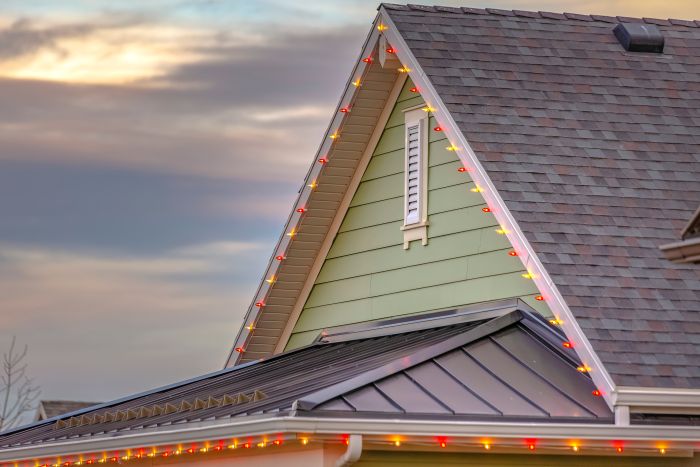
Roofline and landscape lighting both run on low voltage and both end at a timer or an app, but the power, the wiring and the mounting differ in ways that matter when you plan around the other crew.
More homeowners now ask their landscape lighting contractor about the permanent lights on neighbors’ rooflines. The two jobs look like one trade. Knowing where they differ and overlap helps you answer the question.
Two kinds of low voltage
Landscape lighting lives under NEC Article 411. A low-voltage system where there is an isolating power supply plus luminaires and equipment identified for the use, with output circuits of no more than 25 amperes at 30 volts or less (42.4 volts peak)1. Landscape power units listed to UL 1838, Low Voltage Landscape Lighting Systems, are limited to 15 Vac or 30 Vdc output.2,3
Many permanent roofline systems are DC. Installation instructions for linear and track products commonly call for a listed Class 2, 24 V DC constant-voltage power supply4,5, and one warns that any other source can damage the fixture and void the warranty.5 Article 411 also covers lighting equipment connected to a Class 2 power source and requires both to be listed1. So, the two systems share a code article, but a supply sized for path lights is not automatically the one a roofline product calls for, so use the supply the product specifies. Check which NEC edition your jurisdiction has adopted.
Wiring: In the ground versus on the house
Your landscape circuits go underground. NEC Table 300.5, Column 5, allows 6 inches of cover for irrigation control and landscape lighting circuits of 30 volts or less in Type UF or other identified cable or raceway.6
A roofline run stays above grade. It starts at a power supply plugged into an outdoor receptacle and runs along the eave in a mounting channel. One manufacturer’s planning guide calls for one power supply per 200 feet of lights, power injection on longer runs, one controller per 400 lights, and a controller within 100 to 150 feet of the home’s Wi-Fi.7 These figures are one vendor’s examples and vary by product. Another manufacturer says to put the power feed end at the highest point of the run to limit exposure to water runoff.5
Landscape transformers usually switch a whole circuit on a timer or photocell. Roofline systems add a data controller that addresses the lights for color and pattern.7
Mounting: Gutters, fascia and soffit
Roofline products mount to the house. Typical options include screws into wood, adhesive tape on smooth surfaces, edge clips for shingles or gutters, and soffit clips behind the fascia board.7 One manufacturer fastens channel with screws every 18 to 24 inches and presses the strand into it rather than stretching it.5
Check the substrate before fastening anything. The International Residential Code, as quoted by the Polymeric Exterior Products Association, says soffit panels must be individually fastened to a supporting component such as a nailing strip, fascia or subfascia.8 A vinyl or aluminum soffit panel is a finish surface, not structure.
Eave work means ladders. OSHA requires the side rails of a portable ladder used to reach an upper landing to extend at least 3 feet above that landing. Where that is not possible because of the ladder’s length, the ladder must be secured at its top to a rigid support that will not deflect, and a grasping device such as a grabrail must be provided.9 That is a different risk profile from a trencher and a spade.
Where the two jobs overlap
The receptacle. Both systems usually plug in outside. At a dwelling, outdoor receptacles need GFCI protection under NEC 210.8(A)(3), and a receptacle in a wet location needs an enclosure that is weatherproof with the plug inserted, with an outlet box hood listed as extra-duty, under 406.9(B)(1).10 If a transformer and a roofline power supply will share one location, protect it once rather than twice.
The site walk and schedule: both jobs start by measuring the runs, marking outlets and planning where power and controllers will sit before buying parts.7 Uplights and roofline lights often run the same evening hours, so one plan for timers, photocells or apps keeps the property from lighting up in two stages.
What to tell the customer
Explain the difference plainly: different power supplies, wiring above grade, mounting into the house, and ladder work. Whoever does the roofline should coordinate on the receptacle and the schedule.
Cole Williams is with Permanent Lighting Solutions. PLS provides permanent roofline lighting for Nashville-area homes.
Sources
- NEC Article 411 (2011 and 2014 text), ElectricalLicenseRenewal: https://www.electricallicenserenewal.com/Electrical-Continuing-Education-Courses/NEC-Content.php?sectionID=80.0 ↩ ↩
- UL Solutions, Landscape and Outdoor Luminaire Lighting: https://www.ul.com/services/landscape-and-outdoor-lighting ↩
- UL 1838 scope, UL Standards & Engagement: https://www.shopulstandards.com/ProductDetail.aspx?UniqueKey=7876 ↩
- KKDC TWIGGY Track installation guide: https://kkdc.lighting/media/product-attachments/TWIGGY%20Track%20combined%20installation%20guide.pdf ↩
- Tivoli 24V TRACE installation instructions: https://tivolilighting.com/wp-content/uploads/Tivoli_Assets/Product_InstallSheet_Files/2832-Trace%20Vertical_install_Factory%20End%20Prep_10.18.23.pdf ↩ ↩ ↩ ↩
- NEC Table 300.5, ElectricalLicenseRenewal: https://www.electricallicenserenewal.com/Electrical-Continuing-Education-Courses/NEC-Content.php?sectionID=272 ↩
- Big Star Lights, Chromaglow 24V planning guide: https://help.bigstarlights.com/en/articles/12224077-how-to-get-started-with-a-chromaglow-24v-installation ↩ ↩ ↩ ↩
- PEPA soffit installation guide: https://polymericexteriors.org/installation/installation-manual/soffit-installation/ ↩
- OSHA 29 CFR 1926.1053(b)(1): https://www.ecfr.gov/current/title-29/subtitle-B/chapter-XVII/part-1926/subpart-X/section-1926.1053 ↩
- City of St. Paul 2023 NEC dwelling checklist: https://www.stpaul.gov/sites/default/files/2023-06/DSI.Bldg_Electrical_Checklist%20Dwelling%20Furnace%20Air%20Conditioner.pdf ↩